If you search 'learn digital marketing for free' you will find thousands of videos, courses, and threads, most of which assume you already know which channel you want to use. This article does the opposite. It gives you an order of operations: what to understand first, what to practice second, and how to build a small, real project in four weeks without spending money on tools, ad budgets, or paid courses.
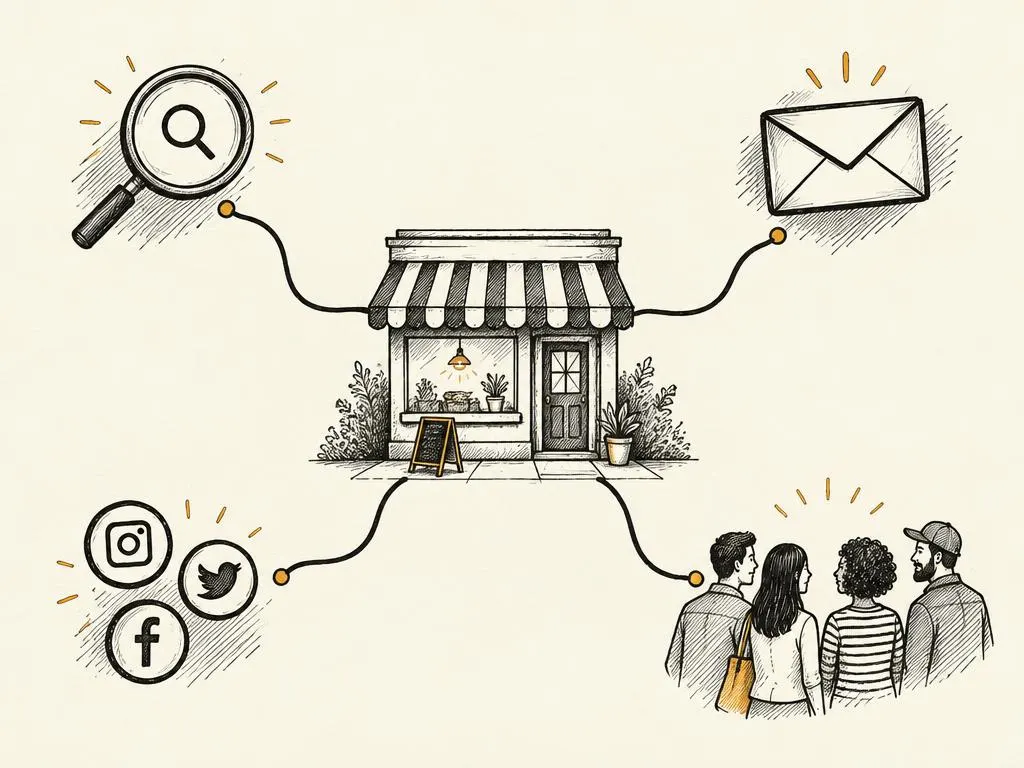
Digital marketing is the set of activities a business uses, across online channels, to reach the right people, communicate a clear offer, and turn attention into enquiries, sales, or repeat purchases. 'Digital' simply means the channel is online (search, social, email, websites, advertising platforms) rather than offline (print, billboards, in-person events). The underlying skills, understanding your customer, writing clearly, measuring honestly, transfer across every channel, which is why this roadmap starts with fundamentals rather than a single platform.
Why order matters more than speed
A common beginner mistake is jumping straight into a platform, for example learning an ads manager interface or chasing social trends, before understanding who the business is trying to reach and why. Tactics without a target audience and a clear offer tend to produce busywork: posts with no strategy behind them, ads with no defined goal, and metrics nobody can interpret. The roadmap below sequences learning so that each week builds on the last.
- 1Foundations: what marketing is, who your customer is, what you're offering
- 2Messaging and content: how you say it, and where attention lives
- 3Discovery: how people find you through search, AI answers, and organic reach
- 4Direct response: email, owned audiences, and paid acquisition
- 5Measurement and AI-assisted growth: proving what worked and scaling it
The four-week beginner plan
Week 1: Foundations
Spend week one understanding what marketing does for a business and who you are trying to reach. Read the articles on what digital marketing is, the difference between digital, growth, and performance marketing, the marketing funnel, and how to define an ideal customer profile. By the end of week one you should be able to describe, in two or three sentences, who your hypothetical or real business serves and what problem it solves for them.
Week 2: Messaging and content
In week two, move from understanding your customer to communicating with them. Study brand voice, copywriting basics such as AIDA and PAS, and how to write a hook that earns attention in the first few seconds of a post or video. Practice by writing three short pieces of content: one social caption, one short video script, and one email, all for the same hypothetical offer.
Week 3: Pick one acquisition channel
Resist the urge to learn every channel at once. Choose one: organic search and AI-visible content, email and an owned list, or a paid channel such as Meta Ads. Go deep on that single channel for a week rather than skimming five. This mirrors how small teams actually operate: most businesses get more value from mastering one channel than from mediocre activity across six.
Week 4: Measurement and review
In the final week, learn the core metrics, CPC (cost per click), CPM (cost per thousand impressions), CTR (click-through rate), CAC (customer acquisition cost), LTV (customer lifetime value), and ROAS (return on ad spend), so you can read your own results honestly. Set up simple tracking (even a spreadsheet counting enquiries by source is enough at this stage), publish or send your first piece of content or ad, and review what happened. The goal is not a perfect campaign; it is a complete cycle of plan, execute, measure, and decide what to try next.
Your four-week learning checklist
- Week 1: write one sentence describing your target customer and the problem you solve
- Week 1: read the articles on what digital marketing is and the marketing funnel
- Week 2: draft a one-paragraph value proposition and test it on a colleague
- Week 2: write one social post, one short video script, and one email for the same offer
- Week 3: choose exactly one acquisition channel and publish your first piece of content
- Week 4: track enquiries or clicks by source, even in a five-row spreadsheet
- Week 4: write three sentences on what you'd change next, based on real results
Your first mini-project
Pick a real small business (yours, a friend's, or a local business you admire) or a clearly labelled hypothetical one. Over the four weeks, produce: one ideal customer description, one value proposition, three pieces of content for one channel, and one simple measurement log. This is the deliverable for this lesson, and it is also the first entry in a portfolio you can show to employers or clients even before you have formal marketing experience.
Common mistakes beginners make
- Trying to learn six channels in parallel instead of going deep on one first.
- Skipping the ideal-customer step and writing generic content that could apply to any business.
- Treating likes, views, or followers as the goal instead of enquiries, sales, or signups.
- Waiting until everything feels 'ready' instead of publishing something small and reviewing it.
- Copying tactics seen on social media without checking whether they fit the actual audience and offer.
When this roadmap is not the right fit
If you already have solid fundamentals and are job-hunting for a specific platform role, for example a paid media specialist position, you may get more value moving straight to the channel-specific modules on Meta Ads or AI advertising and treating this roadmap as a reference rather than a strict sequence. Similarly, if you are supporting an existing business with an established audience and brand voice, you can skip ahead to the measurement and growth modules once you have confirmed the foundational pieces (goals, audience, offer) are already documented somewhere.
Where to go next
After this roadmap, the natural next step is to read what digital marketing actually is in more depth, including the difference between paid, owned, and earned channels, and then move into defining your ideal customer. The measurement glossary later in this module explains the key metrics you'll use throughout every other module.