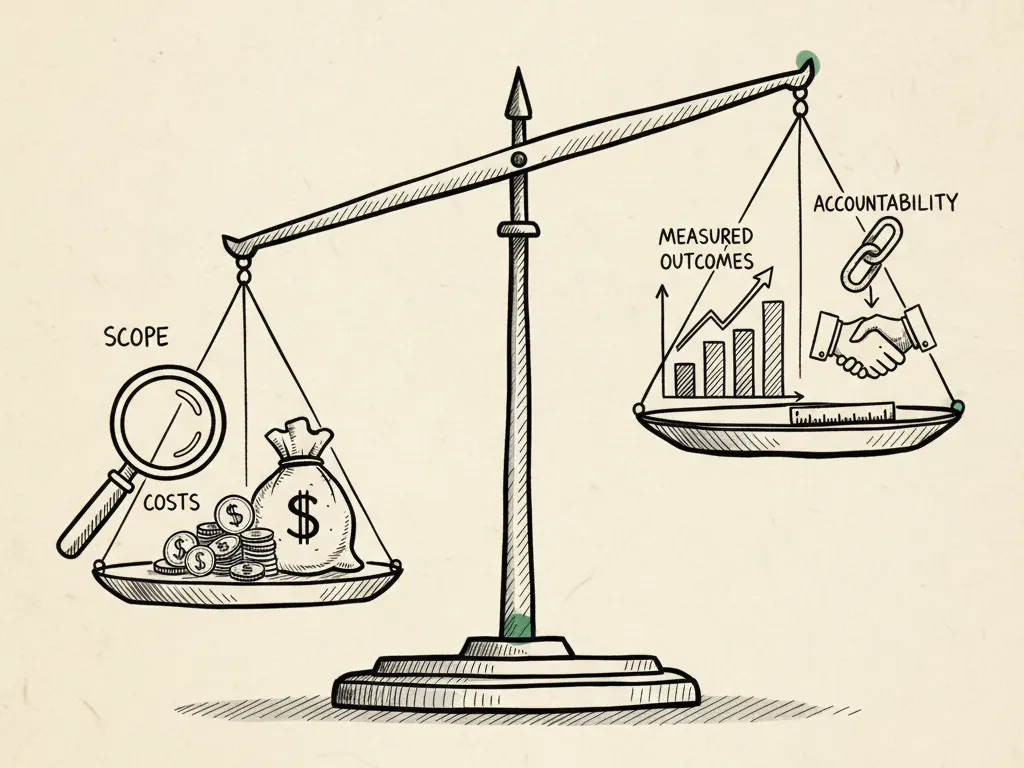
A brief is the document you give a prospective agency before they write a proposal. A weak brief ('we need more leads') forces every agency to guess at your context, which means their proposals will differ wildly in scope and price, not because one agency is better but because they're answering different questions. A strong brief lets every agency respond to the same facts, so you can compare proposals meaningfully and start the relationship with aligned expectations.
Why the brief matters more than the pitch meeting
Many businesses skip a written brief and rely on a verbal conversation or a short call. The problem is that memory and notes from a call are incomplete, and different people on the agency side may walk away with different impressions. A written brief becomes the shared reference point throughout the engagement: when a disagreement arises later about scope, you can point back to what was actually agreed, rather than relying on recollection.
The nine sections every brief needs
1. Business stage
State whether you're pre-launch, early-stage with some traction, or an established business looking to scale a known channel. This changes what kind of agency and engagement makes sense; a pre-launch business often needs positioning and foundational work before it needs media buying.
2. Audience
Describe who you currently sell to and who you want to reach, as specifically as you can: industry, company size, role, or demographic and behavioral traits for consumer businesses. If you have customer data (even a simple list of your best customers), summarize the pattern you see.
3. Offer
Explain what you sell, at what price point, and what makes it different from alternatives a prospective customer might consider. Include your typical sales cycle length and any seasonality.
4. Baseline
Share your current numbers: traffic, leads, conversion rate, customer acquisition cost, average order value, or whatever you currently track. Agencies cannot set a realistic goal from nothing; 'we don't track anything yet' is itself useful information and should be stated honestly rather than left blank.
5. Goals
State the specific outcome you want (for example, '30 qualified leads per month' or 'reduce cost per acquisition below $80') and the timeframe. Separate a primary goal from secondary, nice-to-have goals so the agency knows what to prioritize if tradeoffs arise.
6. Economics
Share your available budget range (for both agency fees and ad spend, itemized separately), your margin or typical customer value if you're comfortable sharing it, and any economic thresholds that make a channel viable or not, for example a maximum acceptable cost per lead.
7. Constraints
List anything that limits what the agency can do: brand guidelines, regulatory restrictions (relevant for finance, health, or legal businesses), approval processes, or internal politics the agency should be aware of.
8. Access
Clarify what accounts, tools, and data the agency will need access to (ad accounts, analytics, website CMS, email platform) and who grants that access and how quickly.
9. Responsibilities
State who owns what: does the agency write ad copy, or does your team review and approve every piece? Who handles customer follow-up after a lead comes in? Unclear responsibility is one of the most common causes of poor results being wrongly blamed on one party.
- Business stage: pre-launch, early traction, or scaling
- Audience: who you sell to and who you want to reach
- Offer: what you sell, at what price, and why it's different
- Baseline: current numbers, honestly stated even if minimal
- Goals: specific primary and secondary outcomes with a timeframe
- Economics: budget range, ad spend versus agency fees, acceptable cost thresholds
- Constraints: brand, regulatory, and approval limitations
- Access: which accounts and tools, and who grants access
- Responsibilities: what the agency owns versus what your team owns
Required outputs versus desired outcomes
A brief should separate what the agency will deliver and directly control (required outputs, such as 'twelve blog posts,' 'an ad campaign live by the 15th,' 'a monthly report') from the business results you hope follow (desired outcomes, such as 'more revenue' or 'higher brand awareness'). Outcomes depend on many factors beyond the agency's work, including your sales process, pricing, market conditions, and product quality. A good brief states both, but makes clear that contractual accountability usually lives with the outputs, while outcomes are a shared ambition tracked together, not a guarantee.
Real available proof, not invented claims
If you have real proof of demand or traction, past customer feedback, existing case studies, a waitlist, repeat purchase data, include it in the brief. This helps an agency assess real market fit. Do not inflate or invent traction to seem more attractive to agencies; a brief built on false information leads to a mismatched strategy and goals that were unrealistic from day one.
Setting reporting expectations
State upfront how often you expect reporting (weekly, monthly), what you expect it to cover (the metrics tied to your stated goals, not just activity like posts published), and in what format. Agreeing this during briefing avoids a mismatch later, for example a client expecting weekly check-ins from an agency that only reports monthly by default.
A reusable blank brief template
- Business stage: [describe where the business is today]
- Audience: [who you currently sell to; who you want to reach]
- Offer: [what you sell, price point, and differentiation]
- Baseline: [current traffic, conversion, cost, or revenue metrics, or state 'not yet tracked']
- Goals: [primary goal with number and timeframe; secondary goals]
- Economics: [agency fee budget; ad spend budget, separate; any acceptable cost thresholds]
- Constraints: [brand, regulatory, or approval limitations]
- Access: [accounts and tools needed; who grants access and timeline]
- Responsibilities: [agency-owned tasks; internally-owned tasks]
- Reporting expectations: [frequency, format, and metrics to include]
Common mistakes
- Writing a goal with no number or timeframe, like 'grow our social media.'
- Withholding baseline numbers out of discomfort, which forces agencies to guess and produces unrealistic proposals.
- Mixing required outputs and desired outcomes without distinguishing them, leading to disputes over accountability later.
- Leaving access and responsibilities undefined until after the contract is signed.
- Inflating traction or past results to look more attractive, which undermines the agency's ability to set a realistic strategy.
- Skipping reporting expectations and being surprised later by how little visibility you have into progress.
When this is not the right tactic
A full written brief can be overkill for a very small, informal engagement, for example a single one-off task with a freelancer you already know well and trust, where a short written confirmation of scope and price may be sufficient. It's also not a substitute for vendor selection itself, evaluating which agency or freelancer is the right fit, which is a separate decision covered in more depth elsewhere in this curriculum. Use this brief once you've decided to formally evaluate one or more agencies and want comparable, well-scoped proposals.
- A vague brief produces vague, incomparable proposals; a specific brief lets you compare agencies fairly.
- Separate required outputs (deliverables an agency controls) from desired outcomes (business results influenced by many factors).
- Share your real baseline numbers and unit economics; agencies can't set realistic goals without them.
- List constraints and access needs (brand guidelines, tool access, approval chains) before work starts, not after.
- A reusable blank brief template saves time on every future vendor conversation, not just the first one.