When a business looks for a marketing agency, one of the first questions is how the agency gets paid. 'Performance-based' and 'results-based' are often used as marketing terms by agencies themselves, promising that payment is tied to outcomes rather than hours. In practice, there are several distinct fee models, each with real tradeoffs, and 'performance-based' can mean very different things depending on how the outcome is defined and measured. This article compares the models neutrally so you can evaluate any agency proposal, including ours, with clear eyes.
Why the fee model matters beyond the price
The fee model shapes incentives. A model paid purely on hours worked has no direct incentive to produce results quickly. A model paid purely on results may push an agency toward whatever generates the measured outcome fastest, even if it's not the best channel for sustainable growth. Understanding the model helps you predict how an agency will behave, not just what it will cost.
The five common models
1. Retainer
A fixed recurring fee (commonly monthly) for an agreed scope of ongoing work, for example managing campaigns, producing content, and reporting. The agency is paid regardless of the specific outcome that month, though scope and expectations are usually defined in advance. This model gives both sides predictable cash flow and works well for ongoing, multi-channel work where results depend on many compounding factors rather than one isolated action.
2. Project fee
A fixed, one-time fee for a defined deliverable with a clear start and end, for example building a website, running a single campaign launch, or producing a brand strategy document. Payment is tied to delivering the agreed scope, not to a business outcome like sales. This suits well-scoped, finite work rather than ongoing growth management.
3. Qualified-lead fee (cost-per-lead or pay-per-lead)
The agency is paid a set amount for each lead that meets a pre-agreed definition of 'qualified' (for example, a named person with contact details who meets a basic fit criterion, verified by the client). This requires a precise, written definition of 'qualified' agreed before work starts; without it, disputes over which leads count are common. Ad spend to generate those leads is typically paid separately by the client, not bundled into the per-lead fee.
4. Revenue share
The agency receives a percentage of revenue (or sometimes gross profit) attributed to its work, instead of or alongside a fee. This requires an agreed attribution method (how revenue gets credited to the agency's campaigns versus other sales channels or existing demand) and a clear definition of which revenue counts, for example first purchases only, or all purchases from referred customers within a time window. Revenue share works best when attribution can be made reasonably clean, such as a dedicated landing page or a unique offer code.
5. Hybrid
A smaller base retainer plus a bonus or share tied to performance. This is common in practice because a pure performance model can be financially risky for an agency (covering staff time with no guaranteed income) while a pure retainer gives the agency no direct stake in outcomes. The hybrid splits risk between both sides.
| Model | What's measured | Who bears most risk | Best suited for |
|---|---|---|---|
| Retainer | Scope of work delivered | Client | Ongoing, multi-factor growth work |
| Project fee | Deliverable completion | Client | Well-defined, finite projects |
| Qualified-lead fee | Leads meeting agreed definition | Shared | Lead generation with clean qualification criteria |
| Revenue share | Attributed revenue or profit | Agency (more) | Clean attribution, e.g. dedicated funnel or offer code |
| Hybrid | Scope plus an agreed outcome | Shared | Most ongoing agency relationships |
Defining the outcome unit
Whatever model is used, the single most important step is writing down exactly what counts as the measured outcome, in enough detail that neither side can reasonably disagree later. For a 'qualified lead,' this means specifying the required fields, any disqualifying criteria (wrong industry, wrong budget range), and who makes the final qualification call. For 'revenue,' this means specifying whether it's gross revenue, revenue net of refunds, or gross profit, and over what attribution window. Vague outcome definitions are the most common cause of disputes in performance-based arrangements.
Separating ad spend from agency compensation
Ad spend (what's paid to Google, Meta, or another platform to run ads) and agency compensation (what's paid to the agency for its work) are two different costs and should always be itemized separately. A client comparing a $3,000/month retainer against a $5,000/month 'all-in' performance fee needs to know what ad spend is included in each, otherwise the comparison is meaningless. This separation also matters for calculating true ROAS (return on ad spend) versus the all-in cost of the marketing program.
Attribution, responsibilities, and quality conditions
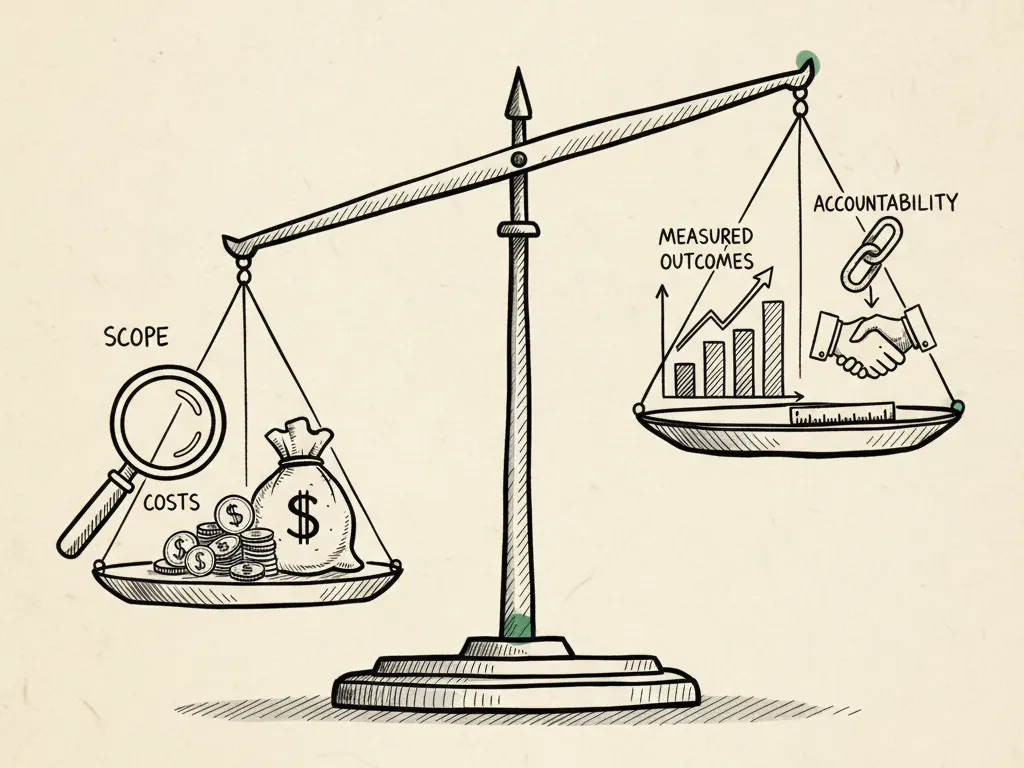
A results-based arrangement needs agreement on: attribution (how a result is credited to the agency's work, for example via a tracked form, a dedicated phone number, or a unique code), responsibilities (what the agency controls, such as ad creative and targeting, versus what the client controls, such as sales follow-up or website speed, which also affect results), and quality conditions (what disqualifies a 'result,' such as a lead who never responds to follow-up, or a sale that's later refunded). Without these agreed in writing, a results-based fee can become a source of conflict rather than clarity.
A neutral fee-model comparison checklist
- Is the outcome unit (lead, sale, revenue) defined precisely enough to avoid disputes?
- Is ad spend itemized separately from agency compensation in every proposal?
- Is the attribution method agreed, and does it reasonably reflect the agency's actual contribution?
- Are responsibilities split clearly between what the agency controls and what the client controls?
- Are quality conditions defined for what disqualifies a counted result?
- Does the model fit the type of work (ongoing, project-based, or lead generation)?
- Is there a review period to revisit the model if it's not working for either side?
Common mistakes
- Agreeing to a 'performance-based' arrangement without writing down the precise definition of the outcome first.
- Bundling ad spend and agency fees into one number, making it impossible to compare proposals or calculate true ROAS.
- Assuming a revenue-share model removes all risk from the client, when attribution disputes can still arise.
- Not defining responsibilities, so poor results caused by the client's own website or follow-up process get blamed entirely on the agency, or vice versa.
- Choosing a model based only on headline price rather than on which incentives fit the type of work.
When this is not the right tactic
Pure performance or revenue-share models are a poor fit when attribution genuinely can't be made clean, for example a business with many overlapping marketing channels and a long, offline sales cycle, because disputes over credit become almost inevitable. They're also a poor fit for early-stage brand-building or foundational work (strategy, website rebuilds, research) that doesn't produce an immediate, attributable result but is still necessary groundwork. In those cases, a retainer or project fee, paired with clear scope and reporting, is usually more honest than forcing a performance structure onto work that isn't suited to it. This article does not offer or imply any specific pricing, guarantee, or sales offer from our agency; it is intended to help you evaluate any agency's proposal, including ours.
- No fee model removes the need to define exactly what counts as a 'result' before work begins.
- Ad spend and agency compensation are two separate costs and should never be presented as one number.
- Qualified-lead and revenue-share models require agreement on attribution, how a result gets credited to the agency's work versus other factors.
- Pure performance models shift risk onto the agency, which can affect what channels or tactics it is willing to recommend.
- A hybrid model (smaller retainer plus a performance component) is common because it balances cash-flow needs with shared accountability.