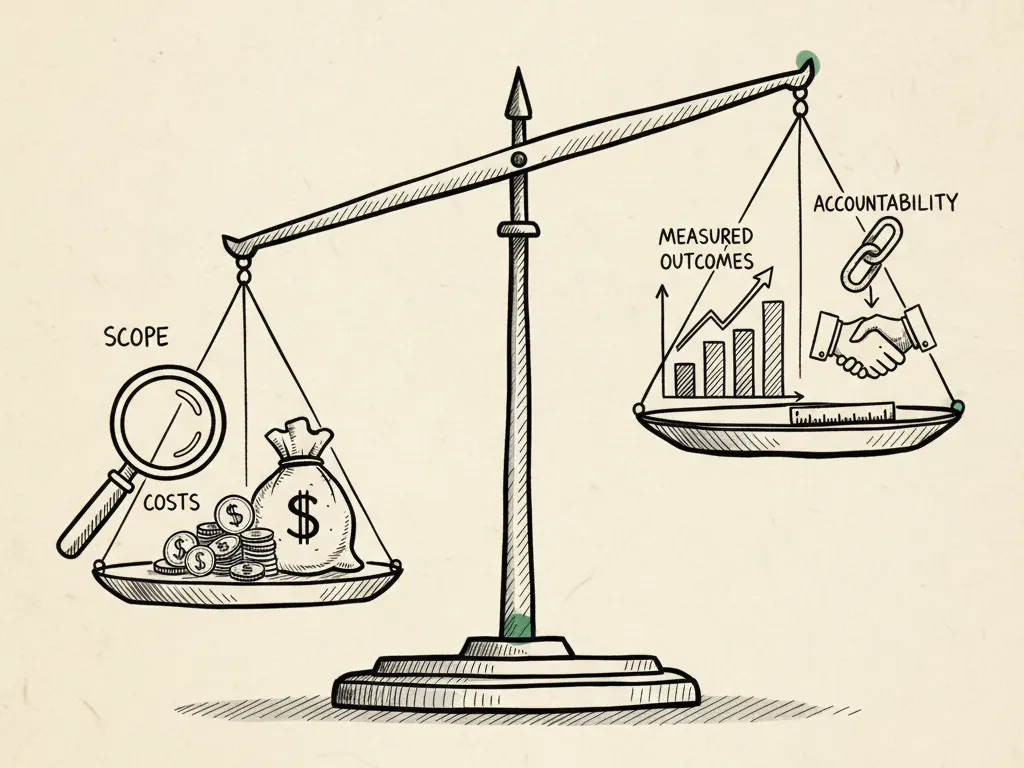
Some agencies market themselves as 'results-based' or offer what sounds like a guarantee: a set number of leads, a target return on ad spend (ROAS, the revenue generated per dollar of ad spend), or even 'guaranteed sales.' Before signing anything built around a guarantee, it helps to understand exactly what can and cannot be promised in marketing, because the word 'guarantee' is used loosely across the industry and the fine print often tells a different story than the headline claim.
What an agency actually controls versus what it doesn't
A sale is the end of a chain with many links. An agency can influence several of those links but does not control all of them.
- 1Marketing activity: ads, content, SEO, email (largely agency-controlled)
- 2Traffic and attention generated (agency-influenced, platform and market dependent)
- 3Leads or enquiries produced (agency-influenced, also depends on offer and landing experience)
- 4Sales process and follow-up (usually client-controlled, see article 098 on lead conversion)
- 5Pricing, product fit, and competitive position (entirely client-controlled)
- 6Final purchase decision (buyer-controlled)
An agency guaranteeing sales is effectively promising to control stages it does not own, including your pricing, your product, your sales team's performance, and the buyer's independent decision. That is why a guarantee tied to marketing activity or lead output is more credible than one tied to final revenue.
Defining the terms that guarantees hide behind
The word 'results' is vague enough to mean almost anything. Precise definitions matter because a guarantee is only meaningful if everyone agrees what counts.
- Qualified lead: an enquiry that meets specific, pre-agreed criteria (budget, need, authority, timeline), not just any form submission.
- Accepted opportunity: a lead that your sales team has reviewed and agreed is worth pursuing, moving responsibility from marketing to sales.
- Revenue: the total value of sales attributed to the campaign, before costs are deducted.
- Profit or contribution margin: revenue minus the direct costs of delivering the product or service, a very different number from revenue.
- Attribution: the method used to credit a sale to a specific marketing effort, which is always somewhat approximate across multiple touchpoints.
Why attribution makes hard revenue guarantees hard to verify
Most buyers encounter a business through more than one touchpoint before purchasing, for example seeing a social ad, later searching the brand name, and finally converting from an email. Attribution models assign credit differently (first touch, last touch, or more complex blended models), and no model perfectly reflects reality. If an agency's guarantee hinges on revenue 'from their campaigns,' ask exactly which attribution method determines whether the guarantee was met, since the same sales data can produce very different attributed totals depending on the method chosen.
What a realistic, accountable commitment looks like
Agencies that are confident in their process typically commit to things they actually control: an agreed number of qualified leads meeting defined criteria, a target cost per lead, delivery of agreed deliverables on schedule, transparent reporting, and a defined review cadence to adjust strategy. Some structure part of their fee around performance metrics they influence, such as cost per qualified lead, rather than final revenue they don't fully control.
Spotting misleading guarantee language
- Vague outcome words ('results,' 'growth,' 'success') with no written definition of what counts or how it's measured.
- Guarantees based on 'revenue' or 'sales' with no attribution method specified in the contract.
- Refund or guarantee clauses with conditions so narrow (minimum budget thresholds, required creative approvals, timing windows) that the agency rarely has to honor them.
- Case studies presented as typical results without disclosing sample size, time period, or whether comparable businesses underperformed.
- Pressure to sign quickly before you can verify claims with the agency's actual past clients.
A guarantee-and-accountability due-diligence checklist
- Get the exact metric defined in writing (qualified lead, opportunity, revenue, or profit) with explicit criteria
- Confirm the attribution method used to measure the claimed guarantee or result
- Ask what happens if the guarantee isn't met: refund, extended service, or no consequence
- Request references from at least two comparable current or former clients, not only curated case studies
- Clarify which stages the agency controls (activity, leads) versus what you control (sales process, pricing, product)
- Check for minimum spend, timing, or approval conditions that could void the guarantee
- Confirm reporting cadence and what raw data you can access yourself, not only agency-summarized dashboards
- Ask directly: 'What have you seen go wrong when this guarantee wasn't met for a past client?'
Common mistakes
- Signing based on a guaranteed ROAS or revenue figure without checking how it's calculated or attributed.
- Assuming 'performance-based pricing' means the agency guarantees sales, when it may only tie fees to lead volume or ad spend efficiency.
- Not asking what counts as a 'qualified' lead, which can let an agency hit a lead quota with low-quality enquiries.
- Treating case studies as proof of typical results rather than as selected examples.
- Ignoring that your own pricing, product, and sales process affect outcomes as much as the agency's marketing work.
When this is not the right tactic
If you are evaluating a very early-stage or experimental channel where no one, agency or in-house, has reliable benchmarks yet, demanding a guarantee of any kind may simply push the agency toward cherry-picked metrics rather than honest testing; a learning-phase engagement with clear reporting may be more appropriate than a guarantee-based contract. Equally, if your own sales process or product-market fit is clearly the weaker link (see article 098 on lead conversion), focusing due diligence on a marketing guarantee misdirects attention from the actual constraint on revenue.
Legal note
This article explains general due-diligence practice and is not legal advice. Contract enforceability for marketing guarantees varies by jurisdiction and specific wording; have a qualified contract reviewed by your own legal counsel before relying on any guarantee clause.