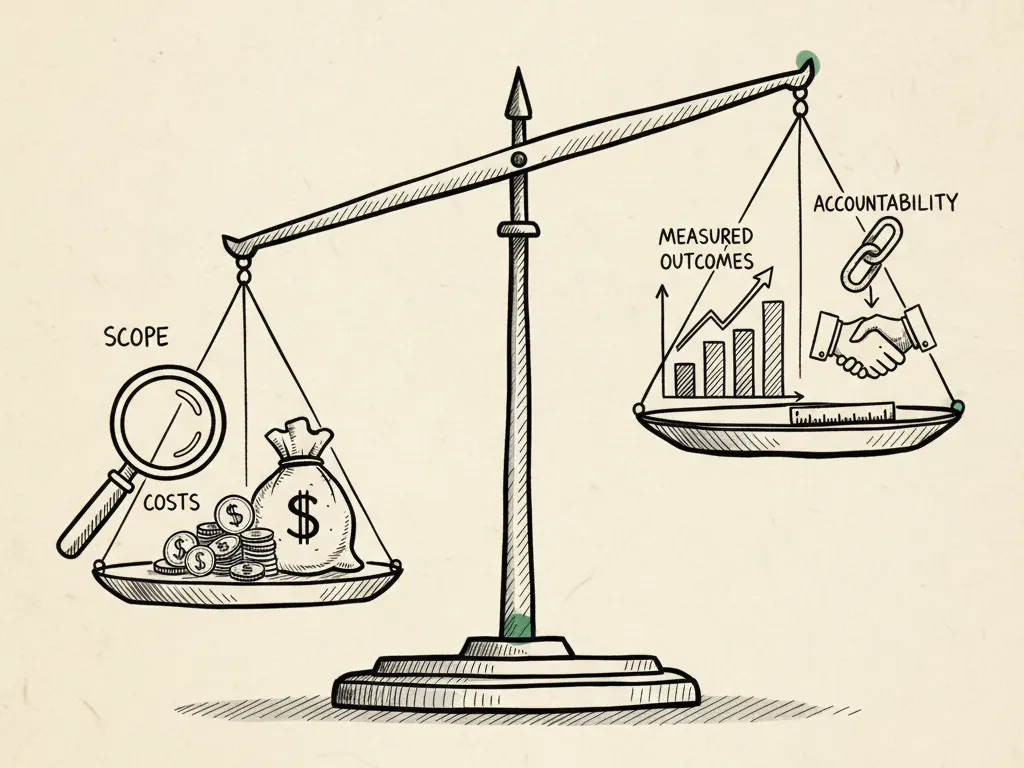
Performance-based marketing arrangements, where a partner is paid based on results rather than only time or media spend, are attractive because they appear to align incentives: the partner only earns when the business benefits. In practice, poorly designed performance models create disputes, cash-flow strain, and perverse incentives. This article walks through the operational components that need to be defined conceptually before any arrangement starts.
Step one: define the payable unit precisely
The payable unit is the thing that triggers payment: a qualified lead, a booked appointment, a closed sale, a new subscriber who stays past a trial period, or a percentage of attributed revenue. Vague definitions are the single biggest source of later disputes. 'A lead' is not precise enough; 'a form submission from a unique contact with a valid phone number and a stated budget above $X, verified by sales within 5 business days' is far more workable, because both sides can check any specific example against the definition.
- 1Pick the unit closest to real business value (a sale) that is still practically measurable
- 2Write the exact qualification criteria for that unit in plain, checkable language
- 3List explicit exclusions (duplicates, spam, existing customers, test submissions)
- 4Define the verification step and who performs it
- 5Set the price or rate per unit, and how it may change over time or volume
Qualification and exclusions
Every performance model needs a shared, written definition of what does not count. Common exclusions include duplicate submissions from the same contact, existing customers re-entering a funnel, spam or bot-generated form fills, submissions failing basic validation (invalid phone numbers, disposable emails), and refunded or chargebacked sales if the unit is a sale. Agreeing these exclusions in advance, with examples, prevents retroactive arguments about whether a given lead or sale 'should count.'
Attribution windows
An attribution window defines how long after a marketing touchpoint a resulting action (a lead, a sale) can still be credited to that touchpoint. A 7-day window after a form fill is very different from a 90-day window after a first ad click, especially for considered, long-sales-cycle purchases like B2B software or home renovation. Both parties should agree the attribution window length, which touchpoint model is used (e.g., last touch, or a documented multi-touch approach), and what happens to actions that occur after the window closes, such as resetting them as unattributed rather than silently paying or silently not paying.
Cost ownership
Decide explicitly who pays for ad spend, landing page hosting, creative production, tracking tools, and any third-party lead verification services. A common structure has the client paying ad spend directly to the platform while the agency's performance fee covers strategy, management, and optimization. Mixing ad spend into the performance fee itself (the agency buys ads and bills a blended rate per lead) changes who bears the risk if costs rise, and should be priced and disclosed accordingly.
Reporting, verification, and dispute handling
Define a reporting cadence (commonly weekly operational, monthly financial), what data each side can independently verify (ideally both sides can see the same underlying system of record, such as a shared CRM view, rather than relying solely on one party's self-reported numbers), and a concrete dispute process: a defined window to flag a disputed unit (for example, within 10 business days of invoicing), the evidence required to support or reject the dispute, and an escalation path if the two parties cannot agree. Building this process in advance, rather than improvising it during a real disagreement, keeps disputes from damaging the relationship.
| Model | How payment is triggered | Main risk to consider |
|---|---|---|
| Pay-per-qualified-lead | A verified lead meeting agreed criteria | Can reward lead quantity over close quality if qualification is loose |
| Pay-per-sale/appointment | A closed sale or booked, attended appointment | Longer cash-flow delay for the partner; needs clear verification of close |
| Revenue share | An agreed percentage of attributed revenue over a period | Attribution disputes; needs a trusted shared system of record |
| Hybrid (reduced retainer + performance) | A base fee plus a smaller per-unit or share component | More complex to administer but balances cash-flow risk for both sides |
Modeling incentives before signing
Before agreeing to a structure, model how each party would behave if they were purely trying to maximize their own payout under the proposed rules. A pure pay-per-lead model with loose qualification can incentivize a partner to maximize lead volume rather than close rate, since more low-quality leads still generate revenue for them if qualification is weak. A pure revenue-share model with a long attribution window can incentivize a partner to claim credit for sales that would have happened anyway (through brand search or existing customer repeat purchases) unless the attribution window and touchpoint rules are tight. Walking through a few realistic scenarios together, before signing, surfaces these issues while they are cheap to fix.
A deliverable: hypothetical fee calculation
- Payable unit defined precisely with checkable criteria
- Full list of exclusions and how disputed units are flagged
- Attribution window length and touchpoint rule agreed
- Who owns ad spend, tooling, and creative production costs
- Shared system of record both sides can view for verification
- Reporting cadence and format agreed
- Dispute window, required evidence, and escalation path documented
- Rate or percentage, and any conditions for it changing over time or volume
Common mistakes
- Leaving 'qualified' undefined until the first dispute forces an argument over it.
- Using an attribution window that does not match the real sales cycle length for the business.
- Relying on only one party's self-reported numbers with no shared system of record.
- Ignoring how the fee structure changes incentives, then being surprised by a flood of low-quality leads.
- Treating a performance-only model as risk-free for the client when ad spend, tooling, or opportunity cost still carry real risk.
- Skipping a written dispute process and improvising one during an actual disagreement.
When this is not the right tactic
Performance-based models are generally unsuitable for brand-building or early-stage awareness work, where outcomes are not reliably attributable to a single action within a reasonable window. They can also be unsuitable for businesses with very long or highly variable sales cycles, where a partner would carry cash-flow risk for many months before seeing payment, or for highly regulated industries where lead qualification and compensation structures may face specific legal constraints that require dedicated legal review well beyond this operational overview. Finally, if neither party can agree on a trustworthy shared system of record for verification, a performance model is likely to generate disputes regardless of how well the contract is written, and a simpler retainer or project-fee structure may serve better until trust and shared data are established.