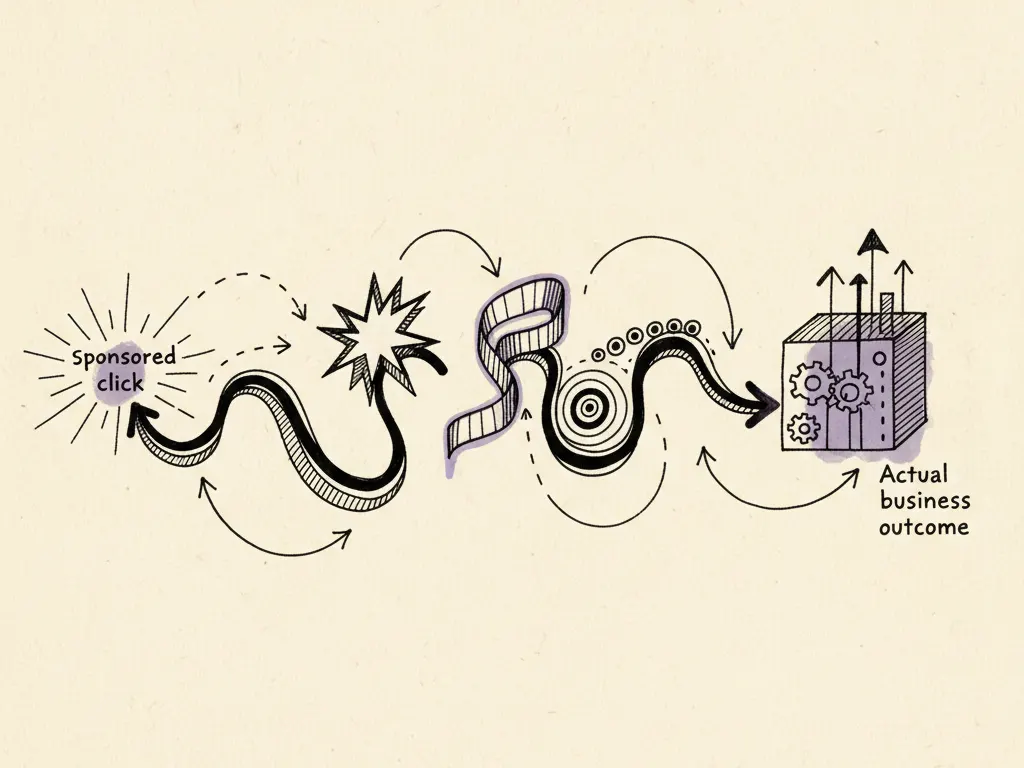
A business that only measures form submissions is measuring the easiest, least meaningful part of its funnel. Most form fills are not sales; some are spam, some are poor-fit enquiries, and some simply never respond to follow-up. Connecting what happens after the form, qualification, proposal, close, back to the original marketing source is what turns a lead-generation report into an honest revenue report. This is often called closed-loop measurement.
Define outcome stages before you connect anything
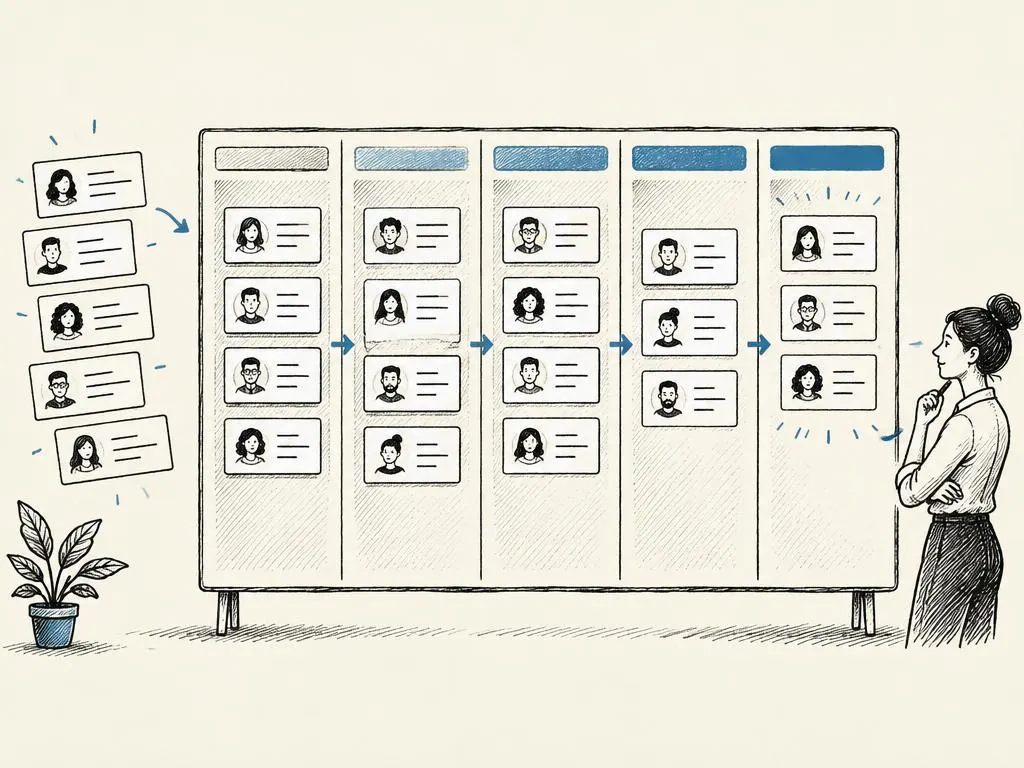
Before building any technical integration, write down the stages your sales process actually uses, in order, and define each one in a sentence a salesperson and a marketer would both agree with. A common structure separates a submitted lead (anyone who filled out a form or called), a qualified lead (meets basic fit and intent criteria, verified by a human or a defined rule), an accepted opportunity (sales has taken ownership and believes it is winnable), and a closed sale. Skipping straight from 'lead' to 'sale' hides the step where most volume is lost, and conflating 'submitted' with 'qualified' is one of the most common ways lead-gen reporting misleads stakeholders.
Verify supported integrations before you design the pipeline
Ad platforms and CRMs change their supported integrations and data requirements over time, and marketing teams sometimes design a reconciliation process around a feature that is not actually available in their account, region, or plan. Before building anything, check the platform's own current documentation for offline conversion imports, supported CRM connectors, required fields (such as a click identifier or hashed contact details), and any volume or timing limits. Treat vendor documentation, not a blog post or a colleague's memory, as the source of truth, and note the date you verified it.
Mapping identifiers responsibly
Matching a CRM record back to an ad interaction usually relies on an identifier captured at the moment of the original click or form submission, such as a click identifier parameter or a hashed version of an email address or phone number, passed through to the CRM and later sent back to the platform alongside the outcome. Capture only what you need for matching, store it securely, and be able to explain to a customer what identifier was used and why, consistent with your privacy policy and applicable consent requirements. Avoid building matching logic around identifiers a platform does not document as supported, since undocumented workarounds can break silently when a platform updates its systems.
Handling deduplication
The same person can generate more than one lead record: they might fill out a form twice, call after previously emailing, or be re-entered by a different salesperson. Deduplication rules, commonly based on matching email or phone number combined with a time window, prevent one real prospect from being counted as several leads or, worse, several 'closed sales' if a record is split. Decide and document the dedup rule before reporting results, and apply it consistently across channels so no single channel is unfairly advantaged or penalized by looser matching.
Handling delayed outcomes
Sales cycles in B2B (business-to-business) and considered-purchase businesses often run weeks or months, so the outcome of an ad click is frequently unknown when the click happens. A reconciliation process should run on a schedule, for example weekly or monthly, pulling newly closed or newly disqualified records and sending the updated outcome back to the platform or reporting tool, rather than a single one-time upload that misses everything that closes later.
Separating submitted leads from accepted opportunities in reporting
Marketing dashboards should show submitted leads, qualified leads, and accepted opportunities as separate numbers, ideally alongside the conversion rate between each stage. Reporting only submitted leads to leadership, while sales privately knows that 60% are unqualified, erodes trust in marketing's numbers over time and makes budget conversations harder, not easier.
| Stage | Hypothetical volume | Conversion to next stage |
|---|---|---|
| Submitted leads | 400 | 45% |
| Qualified leads | 180 | 50% |
| Accepted opportunities | 90 | 28% |
| Closed-won sales | 25 | — |
Measuring data completeness
Not every sale will successfully match back to a marketing source, due to missing identifiers, manual CRM entry, or records created outside the tracked flow. Measure and report data completeness, the share of closed sales that carry a verifiable marketing source, so stakeholders know how much of the 'closed-loop' picture is actually closed. A completeness rate of 70% is very different from 98%, and both are more honest than presenting matched figures as if they were the whole picture.
A reconciliation checklist and CRM-to-platform map
- Funnel stages defined and agreed between marketing and sales, in writing
- Supported offline conversion or CRM integration verified in current platform documentation
- Identifier capture and storage reviewed against privacy policy and consent requirements
- Deduplication rule documented and applied consistently across all channels
- Reconciliation schedule set (for example weekly exports plus a longer monthly look-back)
- Data completeness rate calculated and reported alongside matched results
Common mistakes
- Reporting submitted leads as if they were qualified leads or sales.
- Building a pipeline around an integration that is not actually documented as supported, then discovering it breaks later.
- Uploading outcomes once and never reconciling delayed sales that close after the fact.
- Letting duplicate records inflate one channel's apparent performance relative to others.
- Never measuring or disclosing the share of sales that could not be matched back to a source.
When this is not the right tactic
Full closed-loop reconciliation is worth the engineering effort for businesses with a real sales process and enough volume to justify the setup; a solo founder closing two or three deals a month by hand may get more value from a simple shared spreadsheet than an automated CRM-to-platform pipeline. It is also not a substitute for consent and privacy compliance: if the identifiers needed for matching cannot be captured and used in a way consistent with your privacy policy and applicable law, build a simpler, aggregate reporting process instead.