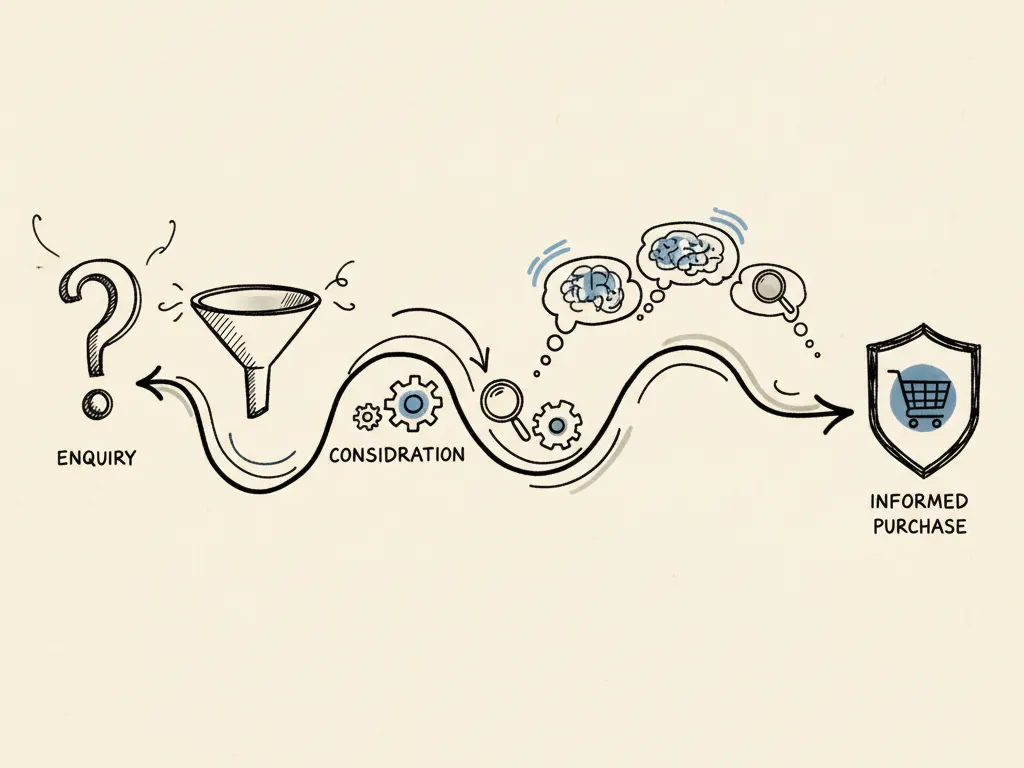
A CRM (customer relationship management system, software that stores and organizes information about leads, prospects, and customers) is where marketing's work either becomes visible or disappears into a black hole. Without a shared, well-defined pipeline, marketing can report plenty of clicks and form fills while sales reports that 'the leads are bad,' and nobody can tell if that's true, because the two teams are describing different things. Connecting marketing activity to sales outcomes starts with agreeing on what each pipeline stage actually means.
Define lead, qualified opportunity, customer, and loss reasons
A lead is a contact who has shown some interest, for example by filling out a form, downloading a resource, or starting a conversation, but has not yet been assessed for fit or intent. A qualified opportunity is a lead that has been reviewed against basic criteria (such as budget range, need, timing, and authority to decide) and is considered a realistic potential customer, usually after some direct contact. A customer is an opportunity that has completed a purchase or signed a contract. A lost opportunity is one that will not convert, ideally tagged with a specific loss reason, such as 'budget,' 'chose a competitor,' 'no longer a priority,' or 'unresponsive after three follow-ups,' rather than left as an undifferentiated 'lost' bucket.
Without agreed definitions, two sales reps might classify the same contact differently: one marks a casual inquiry as a 'qualified opportunity' because the conversation felt promising, while another reserves that label for contacts who've confirmed budget and timeline. Write the definitions down, however simple, and apply them consistently, since reporting accuracy depends entirely on this discipline.
Capturing source data responsibly
Source data (which campaign, channel, or piece of content first brought this lead in) is what lets marketing connect its activity to pipeline outcomes rather than only early-funnel metrics like clicks. Capture this through UTM parameters (short tags added to a URL that record the campaign, source, and medium) on marketing links, or through a simple 'how did you hear about us' field for channels where UTMs aren't practical, like referrals or offline events.
'Responsibly' matters here: only collect the contact information and source detail actually needed to route and follow up with the lead, store it securely, and be transparent in a privacy policy about what's collected and why. Avoid collecting sensitive personal details that aren't relevant to qualifying or serving the lead.
Assigning ownership and follow-up
Every lead entering the CRM should have a clear owner, a specific person responsible for the next follow-up action, and a target timeframe. Leads without an assigned owner are the most common way good marketing leads go cold; a lead that sits unassigned for three days after showing active interest is far less likely to convert than one contacted within an hour. Many CRMs support automated assignment rules (for example, by territory, lead source, or round robin) to prevent this gap.
- 1Lead enters CRM with source data attached (campaign, channel, content)
- 2Deduplication check: is this an existing contact or a genuinely new one?
- 3Lead is assigned an owner automatically or manually, with a follow-up deadline
- 4Owner qualifies the lead against basic criteria (need, budget range, timing, authority)
- 5Lead moves to qualified opportunity, stays as a lead, or is marked lost with a reason
Connecting campaign activity to outcomes
The real value of good CRM hygiene is being able to answer a specific question: which campaigns, channels, or content pieces actually produced customers, not just leads or clicks. This requires that source data persists through the entire pipeline, not just at the point of first contact, so a report can show, for example, that a particular lead magnet produced 40 leads, 9 qualified opportunities, and 2 customers, while a different campaign produced 120 leads but only 1 customer.
Duplicate records vs. new demand
A duplicate record is an existing contact who re-enters the CRM as a 'new lead,' for example by filling out a second form with a slightly different email address or submitting a demo request after already being a newsletter subscriber. Counting duplicates as new leads inflates lead volume and can make a campaign look more effective than it is, or mask the fact that marketing is repeatedly reaching the same small pool of people rather than generating new demand.
Basic deduplication rules, matching on email address, phone number, or company domain, combined with a periodic manual review for close variants, help keep lead counts honest. When a form submission matches an existing contact, the CRM should update that existing record and log the new activity, rather than creating a second entry.
Pipeline table and lead-handoff checklist
| Stage | Definition | Owner action | Typical exit |
|---|---|---|---|
| New lead | Shown interest, not yet assessed | Review within an agreed timeframe (e.g., 24 hours) | Moves to qualified or is marked unresponsive |
| Qualified opportunity | Reviewed and judged a realistic fit | Schedule a call or send a tailored proposal | Moves to customer or lost, with a reason |
| Customer | Completed a purchase or signed contract | Hand off to onboarding or account management | Enters retention or renewal tracking |
| Lost | Will not convert at this time | Tag a specific reason and the stage it was lost at | Archived or added to a future re-engagement list |
- Lead record includes source (campaign, channel, content) via UTM or a direct field
- Deduplication check run against existing contacts before creating a new record
- Owner assigned automatically or manually, with a follow-up deadline
- Shared, written definitions exist for lead, qualified opportunity, customer, and lost
- Loss reason recorded specifically, not left as a generic 'lost' tag
- Pipeline data reviewed regularly by both marketing and sales together
Common mistakes
- Letting marketing and sales use different, unwritten definitions for what counts as a qualified lead.
- Leaving new leads unassigned for days, losing the window when interest is highest.
- Recording 'lost' without a specific reason, which prevents the team from learning anything from it.
- Letting source data get lost as a lead moves through the pipeline, breaking the link between campaigns and outcomes.
- Counting duplicate contact records as new leads, which inflates volume and distorts campaign reporting.
When this is not the right tactic
A full CRM with multiple defined stages can be overkill for a very early-stage solo business with only a handful of leads a month; a simple spreadsheet tracking name, source, status, and next action may be entirely sufficient until volume grows enough to need automation and multiple owners. Heavy pipeline structure is also not useful if sales and marketing haven't yet agreed on basic shared definitions, since adding more software complexity on top of an unresolved disagreement about what 'qualified' means will not fix the underlying reporting gap; that conversation needs to happen first.