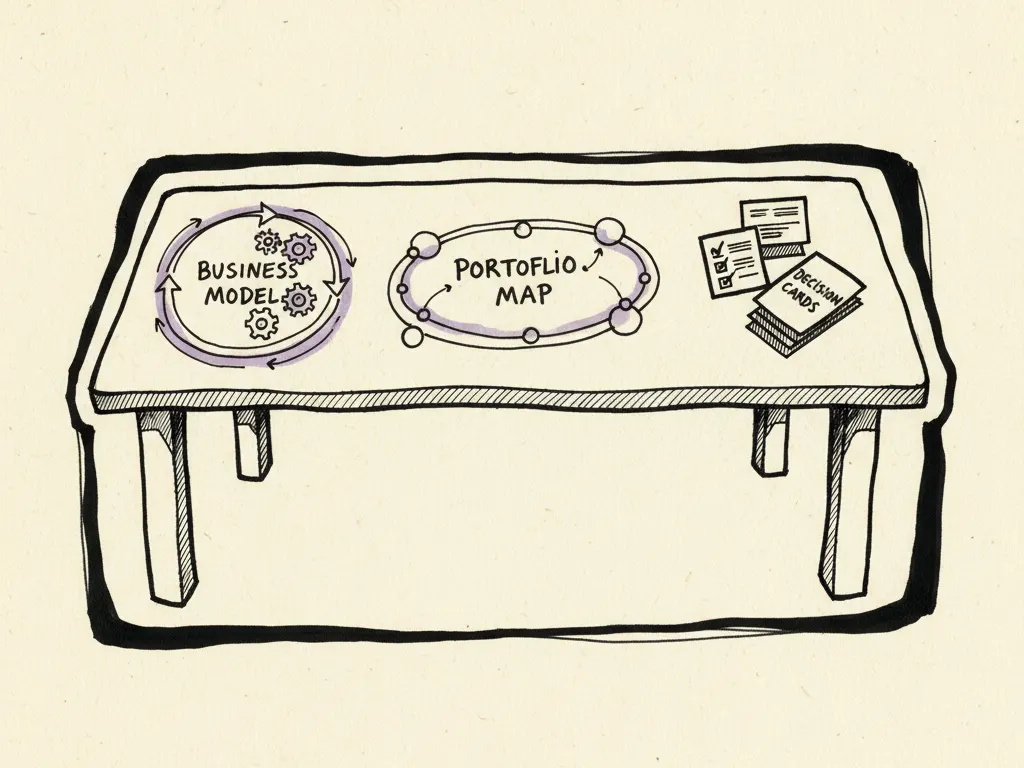
Most marketing budget presentations fail at the board or leadership level not because the tactics are wrong, but because they start in the wrong place. Leading with channel tactics (more paid search, a new influencer program) before establishing the business economics and genuine constraints the growth plan has to work within loses credibility with an audience that is used to thinking in terms of cash, margin, and risk. This article gives a structure for building a growth strategy and budget portfolio that fits a board-level conversation.
Start from business economics, not channels
Before discussing any specific channel, establish three things in plain terms: the company's current unit economics (what it actually costs, including product and fulfilment costs, to acquire and serve a customer, versus what that customer is worth over a defined period), the cash or runway constraint (how much can realistically be invested without threatening near-term operations), and the actual growth target for the period (a specific number, such as net new customers or revenue growth percentage, not a vague aspiration). A growth strategy that is not explicitly tied to these three inputs will be judged by the board on its own terms rather than the business's real constraints.
- 1State current unit economics and what is and is not yet proven about them
- 2State the real cash or budget constraint for the period, not an aspirational number
- 3State the specific growth target the plan is meant to hit
- 4Identify which acquisition and retention channels are proven, and which are unproven
- 5Allocate budget as a deliberate portfolio across proven and experimental bets
- 6Present named scenarios with explicit assumptions and dependencies
Assessing acquisition and retention constraints
A growth strategy needs to be honest about what is actually limiting growth right now. Common constraints include acquisition channel saturation (a channel that has been scaled until its marginal return is falling), a retention or churn problem that makes new acquisition less valuable because customers leave quickly, a conversion constraint (traffic exists but does not convert), or an operational constraint (the business cannot fulfil or service more customers without further investment). Naming the real constraint changes where budget should go; pouring more spend into acquisition when retention is the actual bottleneck wastes money that would be better spent on the retention problem.
Allocating a deliberate budget portfolio
Treat the marketing budget as a portfolio with two broad categories. The 'proven' allocation funds channels and tactics with a credible track record for this specific business (not industry benchmarks), sized to maintain or modestly grow current performance. The 'experimental' allocation funds a small number of deliberately tested new bets, each with a defined test budget, success criteria, and a decision point for whether to scale, iterate, or stop. A common starting split for an established, profitable channel mix is a large majority to proven activity and a smaller, clearly bounded share to experiments, though the right split depends on the business's growth ambition and risk tolerance, and should be stated as a deliberate choice rather than a rule.
| Category | Purpose | How it is evaluated |
|---|---|---|
| Proven allocation | Maintain and incrementally grow what already reliably works | Period-over-period performance against historical baseline |
| Experimental allocation | Test specific new channels, audiences, or offers with bounded risk | Pre-agreed success criteria and a scale/iterate/stop decision at a set checkpoint |
Presenting scenarios and dependencies
Boards generally respond better to a small number of clearly labeled scenarios than to a single point forecast presented as fact. A typical structure presents a conservative scenario (proven channels only, minimal experimentation, lower but more certain growth), a base scenario (the recommended plan, as above), and an aggressive scenario (larger experimental allocation or faster proven-channel scaling, higher potential upside with explicitly higher risk and often lower near-term margin). Each scenario should state its key assumptions (for example, that current channel performance holds, that a key hire is made on schedule, that no major cost increase occurs on a platform relied upon) and dependencies (for example, on supply chain capacity, a product launch date, or a hiring timeline), so the board can see what has to be true for each scenario to play out.
Illustrative values only, representing hypothetical percentage revenue growth targets, not a forecast, guarantee, or benchmark for any real business.
Reporting cadence and decision rights
A credible growth memo defines how often results will be reviewed and by whom, and what decisions sit at which level. A typical structure has the growth team reviewing operational metrics weekly and adjusting tactics within the agreed budget without further approval, leadership reviewing the portfolio monthly and approving any reallocation between the proven and experimental buckets beyond an agreed threshold, and the board reviewing progress against the stated scenario quarterly and approving any change to the total budget or the overall strategy. Stating this explicitly prevents both of two common failure modes: the growth team needing sign-off for routine tactical decisions, and the board being surprised by a major budget shift it never approved.
- Current unit economics and growth target stated in plain terms
- The real constraint on growth identified (acquisition, retention, conversion, or operations)
- Budget split explicitly into proven and experimental allocations, with rationale
- At least two or three named scenarios with explicit assumptions and dependencies
- A stop-loss or checkpoint defined for every experimental bet
- Reporting cadence and decision rights stated for team, leadership, and board level
- No invented statistics, guaranteed outcomes, or unlabeled hypothetical figures
Common mistakes
- Opening the memo with channel tactics instead of business economics and the real constraint.
- Presenting a single forecast as certain instead of labeled scenarios with stated assumptions.
- Leaving the proven/experimental split unstated, so experiments quietly absorb an undefined and growing share of budget.
- Omitting a stop-loss or checkpoint for experimental spend, letting underperforming tests run indefinitely.
- Failing to state decision rights, causing either bottlenecked approvals or ungoverned budget shifts.
- Including invented statistics, client results, or guaranteed growth claims that cannot be verified.
When this is not the right tactic
A full board-level strategy memo is more structure than a very early-stage business needs; a pre-revenue startup with no established channels should focus on cheap, fast experimentation and simple weekly reporting rather than a formal portfolio and scenario framework, which assumes some baseline of proven performance to allocate around. It is also not the right format for a single tactical decision (such as approving one campaign), where a short one-page brief is more appropriate than a full strategic memo. Finally, if the business's unit economics are not yet understood or reliably measured, establishing accurate measurement should come before presenting a budget portfolio built on numbers that are not yet trustworthy.