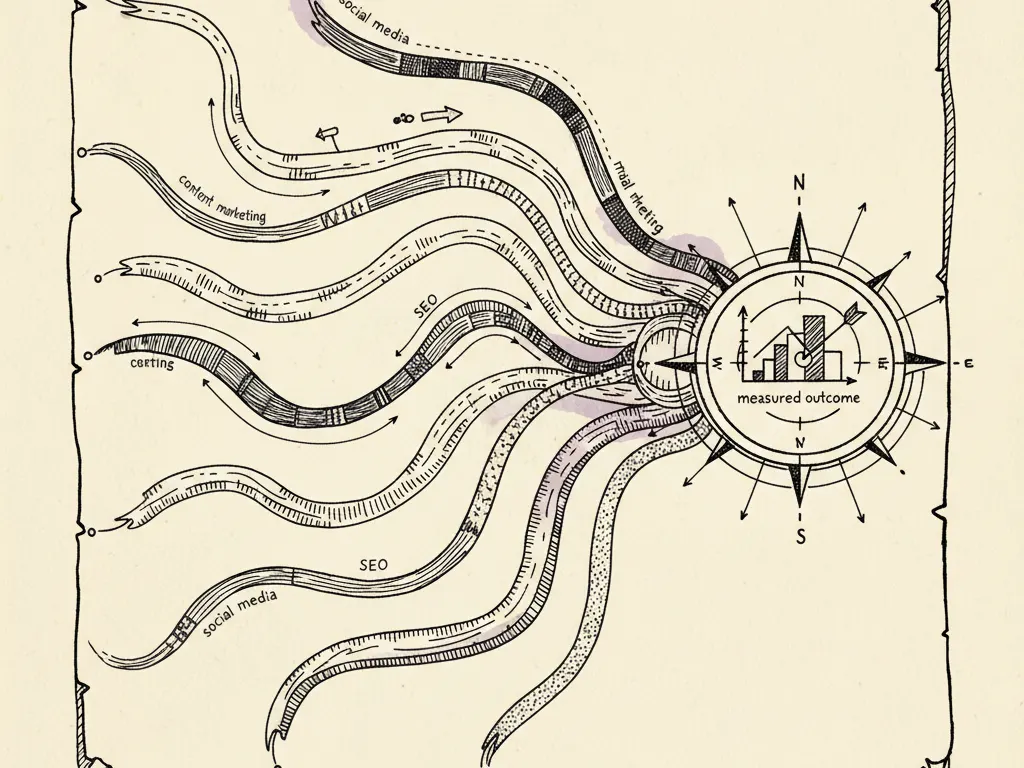
Marketing mix modeling, usually shortened to MMM, is a statistical technique that estimates how much each marketing channel contributed to a business outcome, such as sales or leads, using historical data over time. It is older than most AI-era measurement techniques (the core statistical approach predates digital advertising), but it has become newly relevant as privacy changes have limited some forms of individual-level ad tracking, pushing some larger advertisers back toward aggregate, time-series methods. This article explains what MMM actually assumes, what data readiness looks like, and importantly, when a business does not yet have the data MMM needs to produce a trustworthy answer.
What MMM is modeling and what it assumes
At its core, MMM takes a time series of your business outcome (for example weekly sales) and a time series of inputs (spend by channel, pricing, promotions, seasonality, sometimes macroeconomic factors) and fits a statistical model that estimates how much of the variation in the outcome is associated with variation in each input. Because it works on historical, observational data rather than a randomized experiment, it relies on statistical assumptions rather than direct causal proof: that the relationship between spend and outcome is reasonably stable over the modeled period, that major confounding factors are included in the model, and that there is enough genuine variation in each channel's spend over time for the model to detect its effect at all.
Time-series quality, variation, and confounders
Time-series length and quality
MMM generally needs a meaningful span of historical data, often multiple years for a stable model, though the exact requirement depends on how many channels and how much seasonality you have. Data also needs to be clean and consistently measured over that period: a business that changed its sales reporting system, merged categories, or had major data gaps partway through its history will struggle to build a reliable model across that break.
Variation by channel
A channel whose spend barely changes over the modeled period gives a statistical model almost nothing to work with. If you have spent a nearly constant amount on, say, paid search every month for two years, the model cannot isolate that channel's effect from a constant baseline, even if the channel is genuinely valuable. MMM works best when channels have experienced real variation, deliberate or not, increases, decreases, and pauses, over the historical window.
Confounders
Seasonality, pricing changes, competitor activity, macroeconomic shifts, and major product launches can all move your outcome independently of marketing spend. If these are not captured as separate variables in the model, the model may incorrectly attribute their effect to a marketing channel that happened to vary at the same time. A business launching a major pricing promotion at the same time it increased ad spend, for example, creates a confound that a naive model could misread as an advertising effect.
- A sufficiently long, clean, consistently measured time series of the business outcome
- Historical spend data by channel, with genuine variation (increases, decreases, pauses) over time
- Known confounders captured as separate variables: seasonality, pricing, promotions, major external events
- A business outcome definition that stays consistent across the modeled period
- Enough channels with distinct enough spend patterns that the model can separate their effects statistically
Modeling is not proof
Even a well-built MMM produces an estimate of each channel's contribution, with a confidence interval or similar measure of uncertainty, not a certain fact. Different modeling choices, how seasonality is captured, how long an ad's effect is assumed to last (sometimes called adstock or carryover), and which confounders are included, can shift the estimated contribution of a given channel meaningfully. This is a known limitation of the method, not a sign it was built badly. Responsible use of MMM means reporting a range and the model's key assumptions alongside the headline estimate, and treating the estimate as one input to a decision rather than a verdict.
Comparing MMM with experiments and simpler methods
MMM, incrementality experiments (such as randomized or geo holdouts), and simpler before-and-after comparisons each have a role, and the right choice depends on your data maturity and the stakes of the decision.
| Method | Data needed | Strength | Limitation |
|---|---|---|---|
| Marketing mix modeling | Multiple years of clean, varied historical data across channels | Covers all channels at once, including offline and brand | Observational, assumption-dependent, cannot prove causality alone |
| Incrementality experiment (holdout) | A feasible way to isolate an exposed vs unexposed group for one campaign | Closer to causal proof for the specific thing tested | Usually tests one channel or campaign at a time, not the full mix |
| Simple before-and-after comparison | A few months of consistent reporting | Fast, low-cost, easy to communicate | Highly vulnerable to confounding, no real causal protection |
A data-readiness rubric and methodology-selection table
The deliverable for this lesson is a rubric to score your own readiness, paired with a methodology-selection table to decide what to do with that score.
| Readiness factor | Not ready | Ready |
|---|---|---|
| History length | Under 12 months of consistent data | 18-24+ months of clean, consistent data |
| Channel spend variation | Spend nearly flat across the period | Spend has risen, fallen, and paused meaningfully |
| Confounder documentation | No record of pricing, promotions, or major external events | Pricing, promotions, and major events are logged alongside spend |
| Outcome consistency | Reporting definitions changed mid-period | Outcome measured the same way throughout |
| Number of channels | A single channel with no comparison | Multiple channels with distinct spend patterns |
Illustrative values on a 1-5 hypothetical readiness scale; not derived from real client data and not a scoring standard.
Common mistakes
- Running an MMM on under a year of data and presenting the output with the same confidence as a two-year model.
- Ignoring a known confounder, such as a major price change, because it was inconvenient to collect.
- Reporting a single point estimate for channel contribution without the uncertainty range behind it.
- Treating MMM output as if it were an experiment result, when it is an observational, assumption-based estimate.
- Building a model with a channel whose spend barely varies and expecting a precise estimate for that channel anyway.
When this is not the right tactic
If your business has less than a year of consistent historical data, or spend that has not meaningfully varied across channels, MMM is very unlikely to produce a reliable estimate, regardless of which software or vendor you use; this is a data problem, not a tooling problem. It is also not the right next step if you have a single, specific question about one campaign, such as whether a recent promotion drove incremental sales, where a targeted incrementality test is faster, cheaper, and closer to causal proof. Save MMM for when you want a single, periodic view across your entire channel mix and you have the historical data to support it.
Where to go next
Pair this article with the incrementality testing lesson to understand how experiments can validate or calibrate an MMM's channel estimates, and revisit the Google AI ad features lesson to see how platform-reported numbers fit (or don't) into either approach.