The average person scrolls past hundreds of pieces of content a day, deciding whether to stop in well under a second. A hook is what earns that pause. This article explains the three types of hooks, how to find a question your audience is actually asking, and how to use curiosity without crossing into misleading clickbait.
The three types of hooks
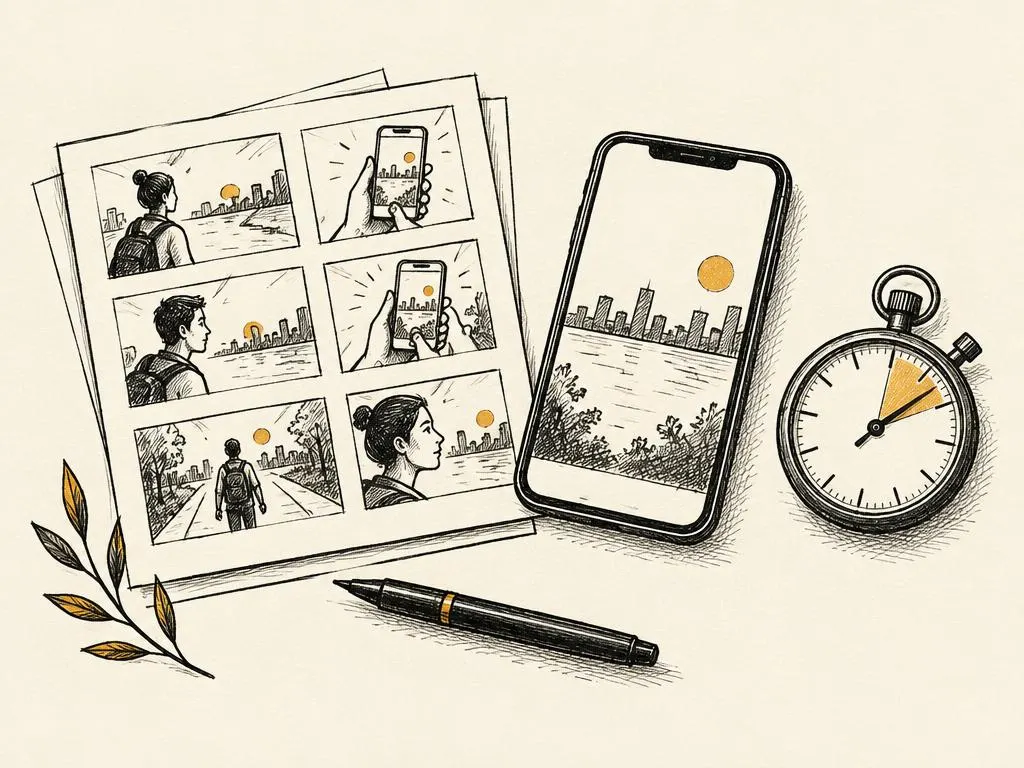
A verbal hook is the spoken or written opening line: a question, a bold statement, a specific claim. A visual hook is what the viewer sees in the first frame: an unexpected image, a close-up, on-screen text, a pattern interrupt. A contextual hook is about relevance rather than technique, why this piece of content seems meant for this specific viewer, often through targeting, timing, or referencing a shared situation. The strongest content usually layers at least two of the three.
| Type | What it is | Example mechanism |
|---|---|---|
| Verbal | The opening line or spoken statement | A specific question or bold, accurate claim |
| Visual | The first frame or image shown | Close-up, unexpected setting, bold on-screen text |
| Contextual | Why it feels relevant to this viewer now | Seasonal timing, a shared situation, platform placement |
Finding the audience's live question
Hooks that work consistently are built from a real question or frustration your audience already has, not from a clever line invented in isolation. Good sources include customer support questions, comments on your own or competitors' posts, reviews, and sales call notes. If you can finish the sentence 'People in my audience keep asking/wondering/worrying about ___,' you have the raw material for a hook.
Curiosity without misleading clickbait
Curiosity-driven hooks work by opening a small, specific information gap: naming a result or claim without yet explaining how. The line between curiosity and misleading clickbait is whether the payoff is real and proportionate. A hook that promises an answer the content never delivers, or exaggerates a claim to get a click, earns short-term attention and long-term distrust, and on most platforms also reduces future reach because viewers drop off before finishing.
- Keep the hook specific: 'the one setting that fixed this' beats 'you won't believe what happened'.
- Make sure the payoff you promise is the payoff you deliver, in the same piece of content.
- Avoid false urgency or manufactured scarcity as a hook mechanism.
- Never misstate a fact, statistic, or result just to make the opening more dramatic.
Connecting the hook to the promised payoff
Every hook makes an implicit promise. A question hook promises an answer. A bold-claim hook promises an explanation or proof. A story hook promises a resolution. Structure the rest of the content so it delivers that exact promise as directly as possible, rather than wandering into unrelated territory before getting there.
A ten-hook starter checklist
- List five real questions or frustrations pulled from customer conversations, reviews, or comments
- Write one verbal hook for each, in your actual brand voice
- Pair at least three with a specific visual hook idea (close-up, on-screen text, setting)
- Check each hook: is the payoff it promises something the content actually delivers?
- Remove any hook that relies on exaggeration, fear, or a misleading implication
Common mistakes
- Opening with a generic statement ('Check this out!') instead of a specific, relevant hook.
- Writing a curiosity hook whose promised payoff never actually arrives in the content.
- Copying a viral hook format without adapting it to a question your specific audience actually has.
- Relying only on a verbal hook when a visual or contextual element could do more of the work.
- Using fear or manufactured urgency as the primary hook mechanism.
When this is not the right tactic
For highly transactional or navigational content, such as a support article someone searched for directly, a scroll-stopping hook is unnecessary and can feel out of place; the reader already arrived with intent, so a clear, direct opening serves them better. Hooks matter most in passive, scroll-based environments like social feeds where attention has to be earned, not in contexts where the audience is already actively searching.
Where to go next
Next, see the 50 hook examples organised by framework, then apply hook structure specifically to short-form video scripts, including pacing and on-screen text.