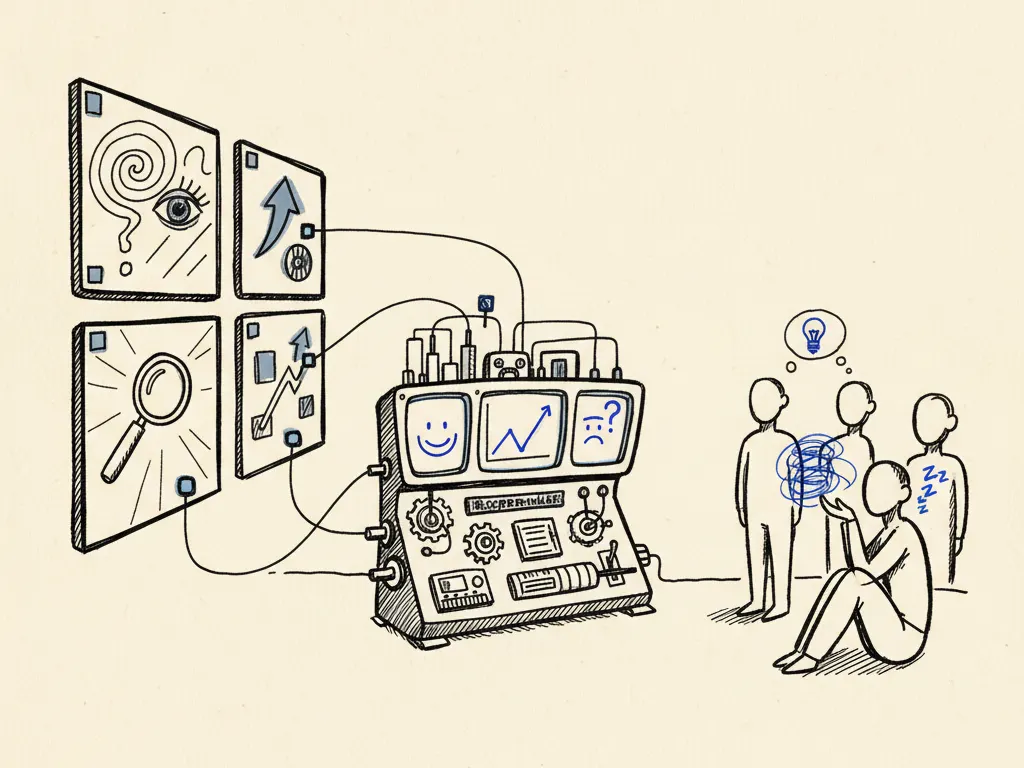
Most advice on social media hooks stops at 'write a curiosity gap' or 'ask a question in the first line.' That is useful for drafting, but it does not tell you whether a given hook is actually working for your business, because a hook can perform brilliantly on views while attracting the wrong audience entirely. This article is about testing, not writing: how to isolate the hook as a variable, measure the right signals, and produce a learning report that compounds across future content instead of a pile of disconnected impressions data.
A hook, in this context, is the first line of text, the opening visual, or the first three to five seconds of a video, whichever element is responsible for stopping the scroll. The basic skill of writing hooks (structures, patterns, examples) is covered in the earlier lesson on hooks; this lesson assumes you can already draft several hook variants and focuses on how to evaluate them like an experiment rather than by gut feel.
Classify hooks before you test them
Before running variants, sort your hook candidates into categories based on two dimensions: the audience problem they name, and the promise they make about what happens if the viewer keeps watching or reading. Two hooks that use different wording but name the same problem and promise the same outcome are not meaningfully different variants; they are restatements. Real variants change the problem framing, the promise, or both.
| Dimension | Example A | Example B |
|---|---|---|
| Problem named | "Your invoices are always late" | "You're underpricing every job" |
| Promise made | "Here's the three-line email that fixes it" | "Here's how to raise prices without losing clients" |
| Audience implied | Freelancers who already invoice | Freelancers unsure of their pricing |
| Risk of mismatch | Attracts people with a different problem | Attracts people not ready to raise prices |
This classification matters because the goal is not the hook that gets the most attention; it is the hook that gets attention from the audience segment who can actually become a lead, customer, or qualified follower. A hook naming the wrong problem can still get views (curiosity is a weak filter), but it recruits viewers your business cannot serve.
Separate hook changes from content quality changes
The single most common testing mistake is changing the hook and the body content (pacing, visuals, call to action, production quality) at the same time, then attributing any performance difference to the hook. If you cannot tell whether a drop in retention came from a weak hook or a boring middle section, the test has not told you anything about the hook specifically.
- Keep the body content, length, format, and posting time as close to identical as possible across hook variants.
- Write all hook variants for the same single piece of content before you decide which one to publish, rather than hooks for different pieces of content you then compare.
- If you must vary content length between a short-form and long-form test, label that as a separate format test, not a hook test.
- Record the exact hook wording and visual used for each post so you can trace outcomes back to the specific variant, not a vague recollection.
What to measure: retention, qualified engagement, downstream action
Reach and views tell you whether a hook stopped the scroll for a large number of people, but they do not tell you whether those people were relevant. Build your measurement around three layers.
A hook that produces high reach but a steep drop-off right after the opening, combined with low profile visits or link clicks, is a reach hook: it stops the scroll without delivering the right audience. A hook with slightly lower reach but stronger retention and more downstream action is usually the better business outcome, even though it looks weaker on a simple views leaderboard.
Control the testing conditions
Social platforms are not clean lab environments: algorithmic distribution, time of day, day of week, and account momentum (recent posting history affecting initial reach) all introduce noise. You cannot fully eliminate this, but you can reduce it.
- Post variants on comparable days and times where possible, and note when that was not possible.
- Avoid testing a hook on a day when something unusual is happening to your account (a post going unusually viral, an outage, a major algorithm change announcement).
- Run enough variants and enough time to see a pattern, rather than declaring a winner from one post against one other post.
- Where the platform supports it, use any native A/B or variant-testing tools, but still apply your own qualified-engagement analysis on top of the platform's raw metrics.
The 20-variant experiment matrix
This lesson's deliverable is a structured matrix of 20 hook variants built from a small number of problem/promise combinations, tested in batches, with a learning report at the end.
- 1Pick one piece of content (one offer, one audience) to hold constant across all 20 variants
- 2Define 4-5 distinct problem/promise combinations relevant to that audience
- 3Write 4 hook variants per combination, varying format: question, bold claim, story opener, number/stat-style claim
- 4Publish in controlled batches (for example, 4-5 per week) rather than all 20 at once, to avoid audience fatigue
- 5Log impressions, retention, qualified engagement, and downstream action per variant in a shared sheet
- 6After the batch, write a short learning report: which problem/promise combination performed best on qualified outcomes, and why
Why sensational reach may not help the business
A hook built purely to shock, provoke, or exploit controversy can spike reach because it triggers an emotional response unrelated to your actual offer. That reach can feel like success on a dashboard while delivering none of the qualified engagement or downstream action your business needs, and it can also attract an audience mismatched to your brand, increasing unsubscribe or unfollow rates once people realize the content does not match the promise. Treat a reach spike as a signal to investigate, not a result to celebrate, until you check retention and downstream action for that specific post.
Common mistakes
- Comparing hooks across different content lengths or formats and attributing the difference to the hook alone.
- Declaring a winner after a single post rather than a batch with repeatable signal.
- Measuring success by views or likes instead of retention, qualified engagement, and downstream action.
- Writing 20 hooks that are superficially different wording for the same problem and promise, rather than true variants.
- Ignoring posting-time and algorithm variance, then over-crediting or under-crediting a hook for external noise.
When this is not the right tactic
Formal hook testing is overkill if you are posting inconsistently, have very low baseline reach, or have not yet validated your offer; in that case, focus on consistency and basic hook-writing skill first, since a controlled experiment on a near-empty account will not produce a reliable signal. It is also not the priority if your content's core problem is production quality, pacing, or a weak call to action rather than the opening; diagnose the actual bottleneck with a few honest audience watch-throughs before building a 20-variant matrix around hooks specifically.