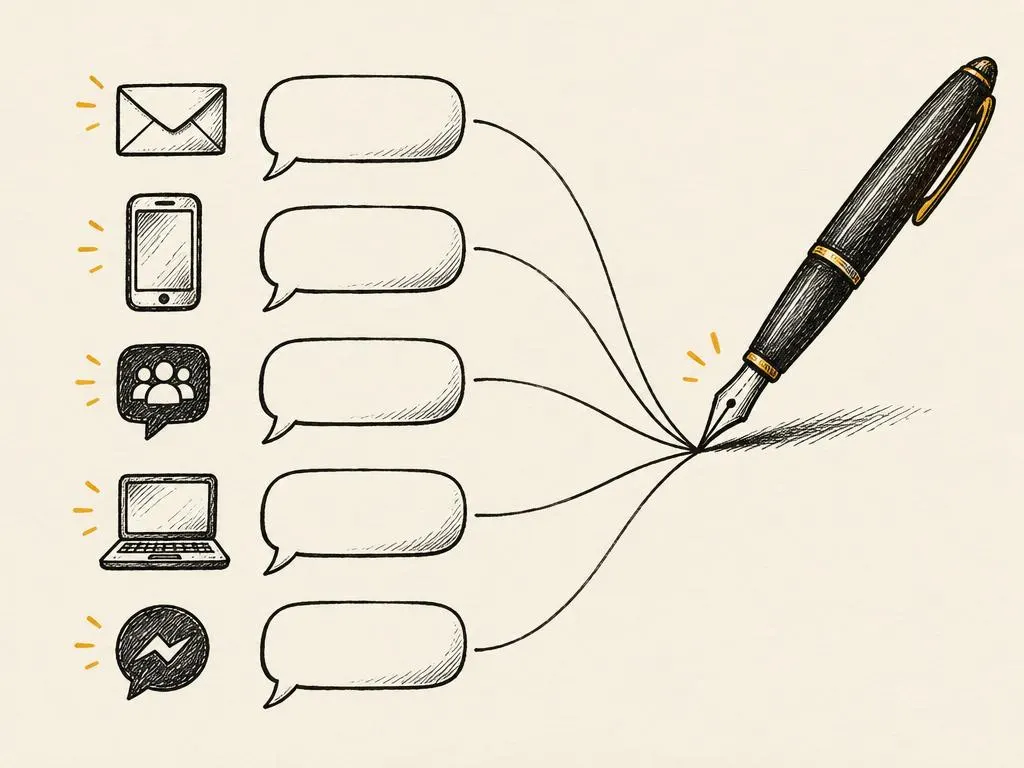
A value proposition answers one question for a specific person: why should I choose this, instead of what I'm already doing? It is not your mission statement, not a list of features, and not a slogan, although a good slogan can compress a good value proposition into a few memorable words. Getting this right matters because every other piece of marketing, ads, landing pages, sales calls, repeats and depends on it.
The five parts of a usable value proposition
- Audience: a specific group, not 'everyone.' The narrower and more real the audience, the sharper the rest becomes.
- Problem: the specific pain or unmet need that audience has, in their language, not your internal jargon.
- Alternative: what that audience does right now instead of buying from you, including competitors, DIY, or doing nothing.
- Benefit: the concrete outcome you deliver that the alternative doesn't, stated as plainly as possible.
- Proof: a credible reason to believe the benefit claim, a mechanism, a guarantee, a specific detail, not just an assertion.
- 1Name the specific audience segment
- 2State their specific problem in their words
- 3Name the realistic alternative they use today
- 4State the concrete benefit you deliver over that alternative
- 5Add one credible, specific proof point
A fill-in positioning framework (deliverable, part 1)
A simple, reusable template: 'For [specific audience] who [problem or need], [product/service] is the [category] that [key benefit], unlike [main alternative], because [proof or mechanism].' This sentence is rarely used word-for-word in final marketing copy, but writing it out forces clarity that then gets rewritten into headlines, ads, and page copy.
Weak positioning vs stronger positioning
Vague claims fail because they could apply to almost any competitor and can't be tested or disproven. Below are three hypothetical before-and-after examples (deliverable, part 2) showing the difference.
Distinguishing an offer from a slogan
An offer is the substantive value exchange: what the customer gets, what they give up (money, time, data), and under what terms. A slogan is a short, memorable phrase used in marketing materials. A business can change its slogan often while keeping its underlying value proposition stable, but if the slogan contradicts the real offer, customers notice quickly and trust erodes.
What counts as credible proof
- A specific mechanism: explaining how the benefit is delivered, not just asserting that it is.
- A specific number or detail that sounds real rather than rounded and vague (when the number is genuinely true and verifiable for your business).
- A risk reversal, such as a clearly stated guarantee or trial period, where applicable to your actual policies.
- Named, verifiable specifics rather than generic claims like 'trusted by thousands' without any way to check them.
Testing messaging against real customer language
Once a draft value proposition exists, compare it against the exact phrases customers used in interviews, reviews, or support conversations (see customer research). If your draft uses words like 'streamline' or 'synergy' while customers say 'I just want it to stop breaking,' rewrite toward their language. The best test is often reading your positioning out loud to someone in the target audience and watching whether they recognize their own problem in it.
| Internal jargon | What a customer might actually say |
|---|---|
| Streamlined workflow solution | I don't want to re-enter the same data three times |
| Best-in-class support | Someone who actually answers the phone |
| Enterprise-grade security | I don't want my customers' data leaked |
Common mistakes
- Writing positioning that could describe any competitor in the category just as accurately.
- Leading with features instead of the outcome the customer actually cares about.
- Skipping the 'alternative' step, which makes the benefit meaningless because there's nothing to compare it to.
- Using unverifiable superlatives ('the best,' 'the most trusted') instead of specific, checkable claims.
- Writing positioning once and never retesting it as the audience, product, or competitive landscape changes.
When a single value proposition isn't the right tactic
If a business genuinely serves several very different audiences with different problems, for example a software tool used by both solo freelancers and large operations teams, a single one-size-fits-all value proposition often becomes too vague to be useful. In that case, it is usually better to write a distinct value proposition for each core segment and route marketing and landing pages accordingly, rather than force one compromise statement to cover everyone.