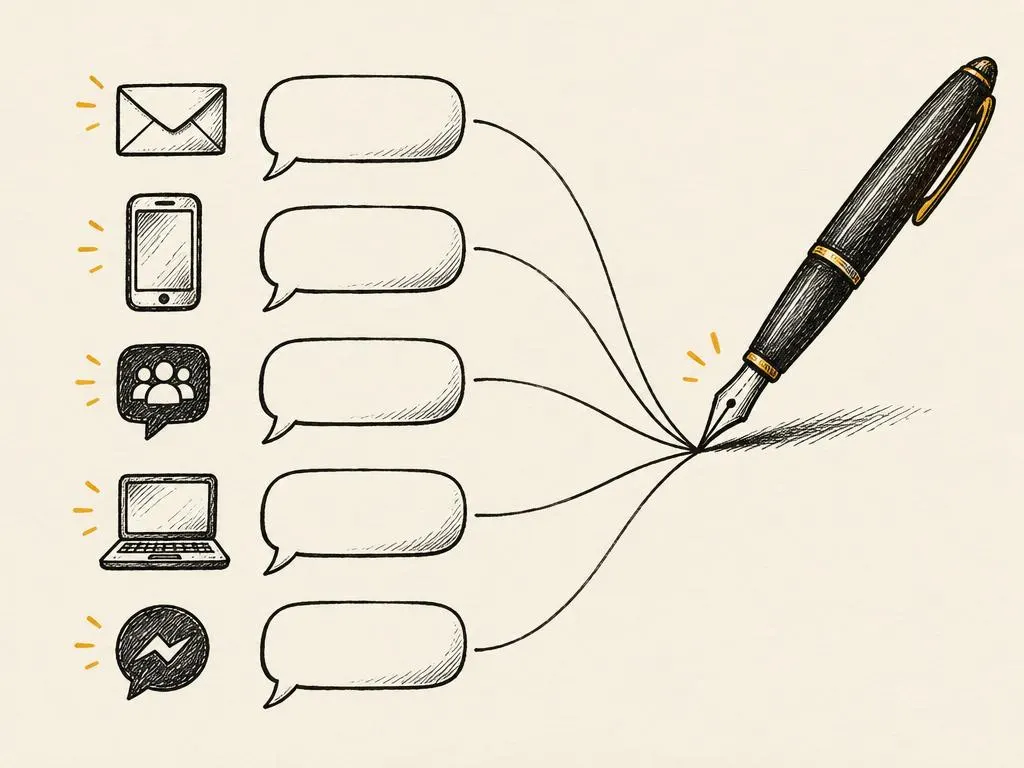
If a stranger read one of your ads, one of your emails, and one of your social captions without seeing your logo, would they recognise all three as coming from the same business? For most small and mid-size businesses, the honest answer is no, because voice gets decided ad-hoc by whoever is writing that day. This article shows you how to fix that with a one-page voice guide you can actually use.
Voice versus tone: a distinction worth keeping
Voice is the stable personality of a brand: the vocabulary it reaches for, the sentence rhythm it prefers, the level of formality it defaults to. Tone is how that same voice flexes for context. A brand with a warm, plain-spoken voice still sounds warm and plain-spoken when apologising for a late order, but the tone shifts toward more care and less humour than it would in a product announcement. Businesses that confuse the two either sound robotic (same tone everywhere, ignoring context) or unrecognisable (voice changes depending on who wrote the post).
Where voice actually lives
Voice shows up in word choice (do you say 'customers' or 'clients' or 'folks'), sentence length (short and punchy, or fuller and explanatory), contractions (do you write 'we're' or 'we are'), and what you joke about, if anything. It should come directly from your actual positioning, who you serve and what you promise them, not from a generic list of 'friendly, bold, authentic' adjectives that could describe any company.
Defining vocabulary and personality from your positioning
Start from your value proposition and your audience, not from a mood board. If your positioning is 'the straightforward accountant for freelancers who hate jargon,' your voice should actively avoid financial jargon and prefer plain verbs. If your positioning is 'the premium, considered option for design-led brands,' short declarative sentences and restrained punctuation will likely serve you better than exclamation points and slang.
- List three to five personality traits that come directly from your positioning, not generic brand adjectives.
- Write five to ten words or phrases you want to use often, in your customers' own language where possible.
- Write five to ten words or phrases to avoid, including jargon, clichés, or anything that contradicts your positioning.
- Decide your default sentence length and punctuation habits (short and direct, or fuller and explanatory).
- Decide where humour, if any, is appropriate, and where it is never appropriate (complaints, pricing, legal matters).
Aligning ads, social, email, and landing pages
The same voice should be identifiable whether someone meets you through a paid ad, a social caption, a welcome email, or your homepage headline. This does not mean every channel reads identically; an ad has far less space than an email, and a landing page needs more structure than a caption. It means the vocabulary, sentence rhythm, and personality stay the same even as length and format change.
| Channel | Length | What stays constant |
|---|---|---|
| Paid ad | Short, 1-3 lines | Vocabulary, promise, call-to-action style |
| Social caption | Short to medium | Opening hook style, personality, humour rules |
| Medium to long | Greeting style, sentence rhythm, sign-off | |
| Landing page | Structured, scannable | Headline vocabulary, proof style, CTA wording |
Building your one-page voice guide
Keep the guide to one page so people actually use it. A longer document becomes a reference nobody opens before writing an ad at 5pm on a Friday.
- Three to five personality traits tied to your positioning, each with a one-line explanation
- Ten approved words or phrases drawn from how your customers actually talk
- Ten words or phrases to avoid, with a short reason for each
- Two or three example sentences showing the voice in a sales context
- Two or three example sentences showing the voice in a support or apology context
- One 'approved' and one 'not this' example ad, caption, or email
An approval checklist for anyone writing copy
- Does this read like it came from a real person who knows this audience, not a generic template?
- Have I used any word from the 'avoid' list? If so, is there a reason this specific exception is justified?
- Would this sentence sound out of place next to our last three emails or ads?
- Does the tone match the situation (celebration, apology, routine update) while the voice stays the same?
- Could I remove this adjective or claim and lose nothing? If yes, remove it.
Common mistakes
- Writing a voice guide of adjectives only ('bold, friendly, authentic') with no vocabulary or examples, so nobody can apply it consistently.
- Letting voice drift channel by channel until the ads sound like a different company than the emails.
- Copying a competitor's voice instead of deriving one from your own positioning and audience.
- Treating the voice guide as a one-time document instead of revisiting it after a rebrand or a shift in audience.
- Using the same tone (e.g. upbeat and jokey) regardless of context, including apologies or price increases.
When this is not the right tactic
If you are a brand-new, pre-revenue business still testing who your customer even is, a fully locked voice guide can be premature; you may spend more time polishing wording than validating the offer itself. In that case, write a lightweight two or three line voice note and revisit it properly once you have real customer language to draw from. Similarly, if you are a solo operator who is the only person who ever writes your copy, a short personal checklist may serve you better than a formal multi-section guide.
Where to go next
Once your voice is defined, the natural next step is applying it inside proven copywriting structures like AIDA and PAS, and later into the full brand and content system covered later in this curriculum.