AI image and copy tools make it easy to generate dozens of ad variants in an afternoon. The problem most teams hit is not generation speed, it's quality control: inconsistent brand voice, unsupported claims, visual styles that clash with existing campaigns, and no clear record of which version was actually approved. A creative production system solves this by defining a fixed sequence of stages, each with its own checks, so AI accelerates the work without bypassing judgment.
This article lays out that sequence for an in-house marketer or small agency team: from research through to tested creative, with the controls that keep output on-brand and factually sound. It assumes you already understand basic prompt structuring and brand voice fundamentals; if not, start with those before building a full production system.
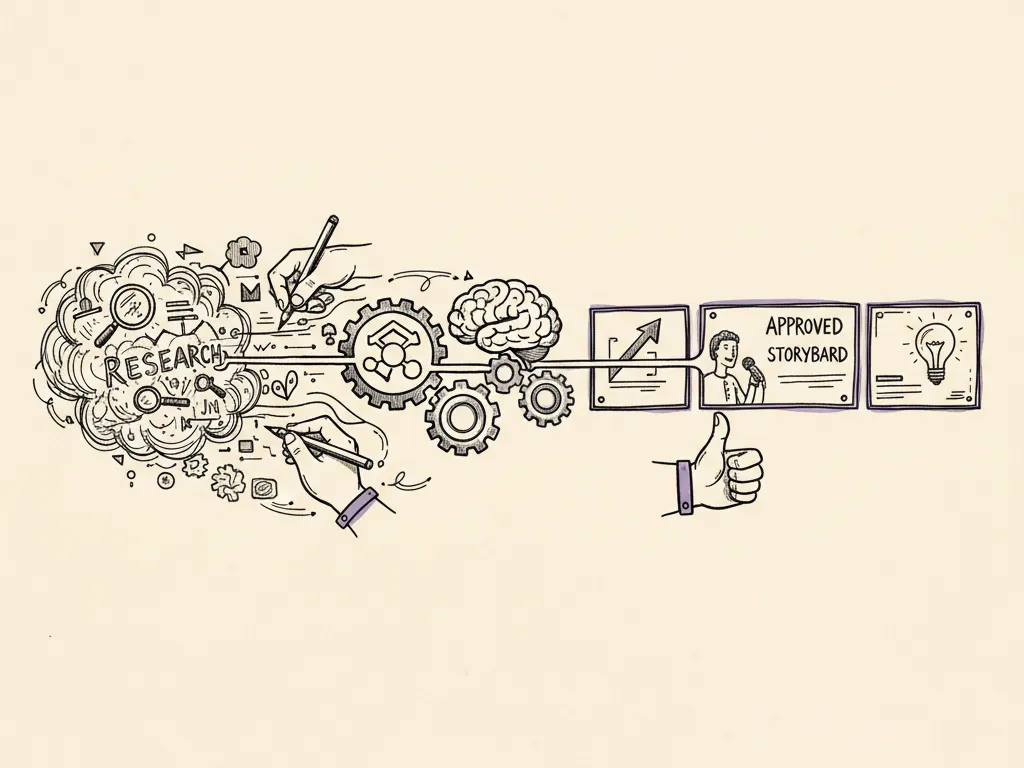
The seven-stage production sequence
- 1Research: gather real product facts, customer language, and competitor examples
- 2Brief: write a one-page creative brief with goal, audience, offer, and constraints
- 3Concepts: generate multiple distinct creative directions, not minor variations
- 4Scripts and copy: draft text for each concept, grounded in the brief's facts
- 5Images and visuals: produce or source visuals matching brand and concept
- 6Review: check brand fit, factual accuracy, and compliance before approval
- 7Test: launch a small controlled test and record results against a baseline
Research: ground the system before anything is generated
Every useful AI creative output starts from real inputs: actual product specifications, pricing, guarantees, customer reviews, and competitor ads you've genuinely observed. Feed these into your brief and prompts rather than asking a tool to invent claims. If a model proposes a statistic, feature, or guarantee you haven't verified, it must be checked against a real source or removed before it reaches a brief.
Brief: the one document every generation step refers back to
A creative brief should state the campaign goal, target audience, core offer, mandatory disclosures, brand voice notes, and anything that must not be claimed. This brief, not a loose chat conversation, becomes the reference document that keeps every AI-assisted output aligned, and it's what a reviewer checks outputs against later.
Concepts: breadth before depth
Ask for genuinely different creative angles, for example a problem-led angle, a social-proof angle, and a comparison angle, rather than ten small rewordings of one idea. Distinct concepts are more useful for testing because they tell you something about what resonates, whereas ten near-identical variants mostly just add review burden.
Scripts and copy: grounded drafting
When drafting ad copy or video scripts with AI tools, include the brief's verified facts directly in the prompt and instruct the tool not to add claims beyond what's provided. Review drafts specifically for invented statistics, implied guarantees, or comparisons to competitors that haven't been checked.
Images and visuals: brand-rule prompting
Maintain a short visual style reference, color palette, typography notes, composition style, and reference it in every image-generation prompt. Flag any AI-generated visual that resembles a real person, trademarked logo, or a competitor's distinctive creative, since these raise both legal and brand-trust issues.
The prompt pack: your consistency layer
A prompt pack is a living document of tested, reusable prompt templates for each stage, brief expansion, concept generation, copy drafting, image generation, each with the brand voice notes and constraints already built in. New team members or freelancers use the pack instead of writing prompts from scratch, which reduces the drift that happens when everyone phrases brand voice slightly differently.
- A brief-expansion prompt template that turns short notes into a full structured brief.
- A concept-generation prompt that asks for named, distinct creative directions with a one-line rationale each.
- A copy-drafting prompt that embeds the brief's verified facts and forbids unlisted claims.
- An image prompt template with the brand's style reference attached.
- A review prompt that checks a draft against the brief and flags unsupported claims.
The approval checklist
- Matches the brief's goal, audience, and offer
- Every factual or numeric claim traces to a verified source
- Brand voice, tone, and visual style are consistent with existing approved assets
- No invented testimonials, guarantees, or comparisons to specific competitors
- Required disclosures or disclaimers are present where applicable
- Asset is tagged with version number, date, and approver name
- A clear owner is assigned for monitoring the test once live
Version control: avoiding the wrong asset going live
A production board (a simple spreadsheet or kanban tool works) should track each asset's stage, version number, and approval status. Use a consistent naming convention, for example concept name, version number, and approval date, so a traffic manager can tell at a glance whether an asset in a folder is the approved final version or an earlier draft. This matters more as AI tools make it cheap to produce many near-identical versions quickly.
Measuring useful creative throughput
The point of this system is not to generate more assets, it's to generate more assets that actually ship, test cleanly, and perform. Track approved variants per week (not drafts generated), time from brief to approval, and performance of tested creative against your account's recent baseline, not against an assumed universal benchmark.
Illustrative values for one hypothetical weekly cycle; not a benchmark for any real account.
Common mistakes
- Letting AI tools invent product claims or statistics that are never checked against a real source before publishing.
- Skipping the brief and prompting ad hoc, which causes brand voice to drift between assets.
- Treating raw asset volume as a success metric instead of approved, tested throughput.
- No version naming convention, leading to an unapproved or outdated creative accidentally going live.
- Generating only minor copy variations instead of genuinely distinct concepts worth testing.
When this is not the right tactic
A full production system is overhead a solo founder running one or two ads a month likely doesn't need; a simple brief template and a manual check is enough at that scale. It's also not a substitute for genuine creative strategy, if your underlying offer or audience targeting is wrong, a faster production pipeline just produces more of the wrong creative, faster. Build this system once you have recurring creative volume, multiple contributors, or a brand consistency problem that manual review alone isn't solving.
Getting started
Start small: write one brief template, build a five-prompt pack for your most common creative type, and run one full cycle on a real or hypothetical campaign before scaling the system across your whole content calendar.