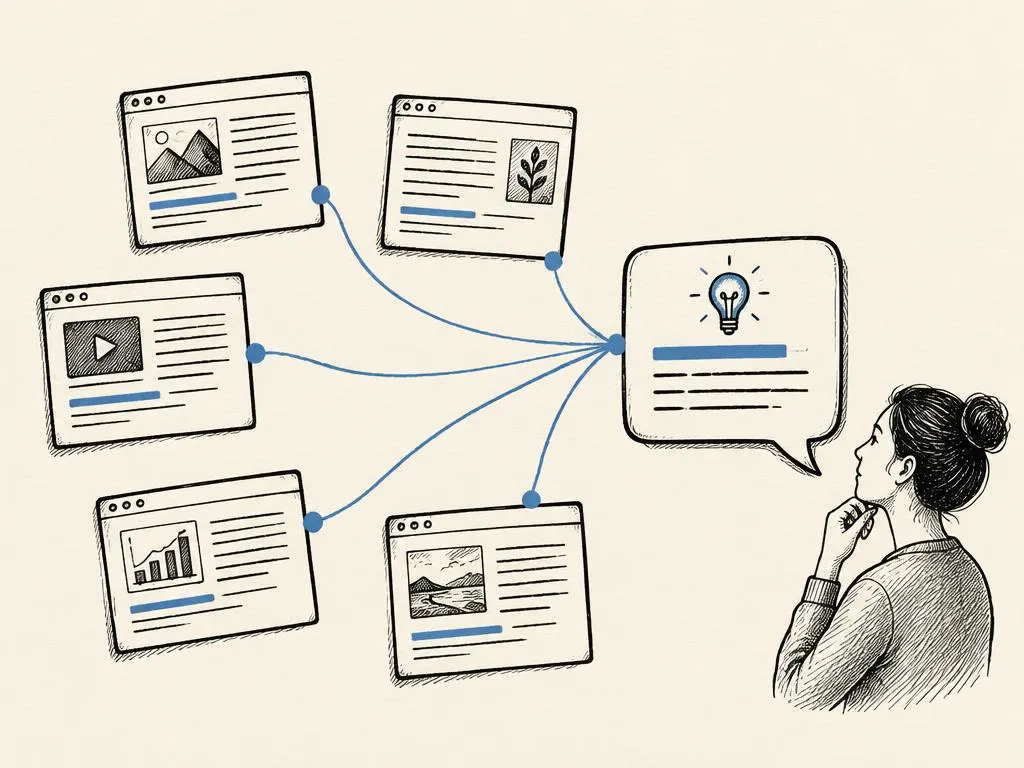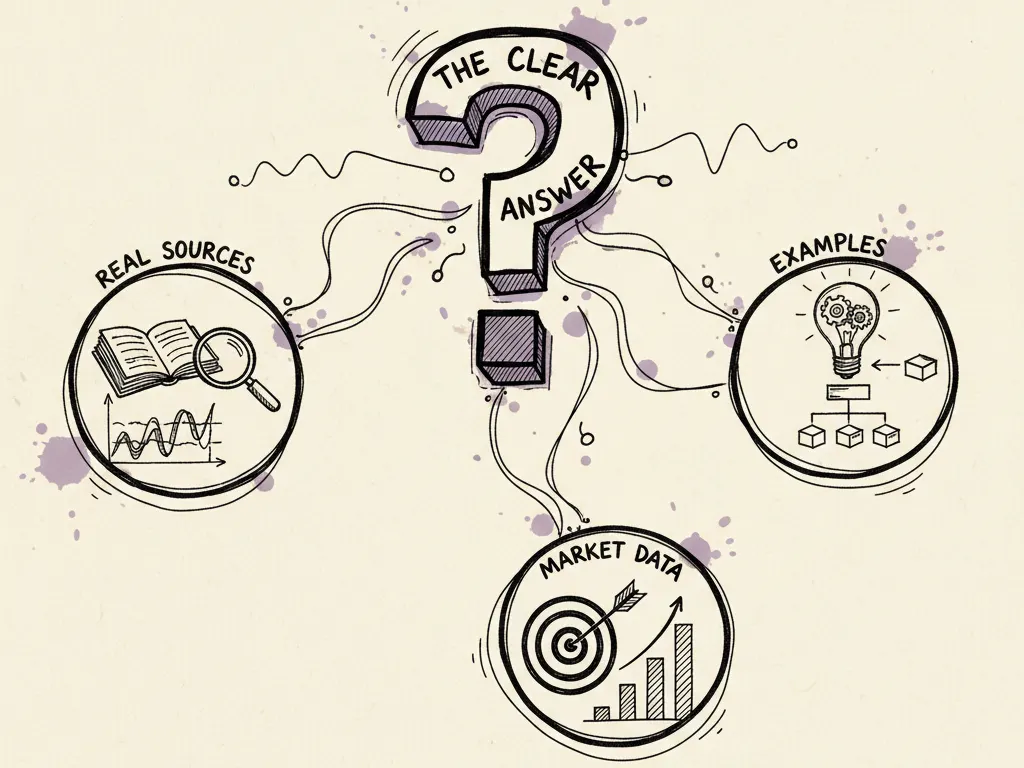
By the time you're ready for this lesson, you likely already understand the basics of AI search visibility, writing clear, well-structured content that answer engines like AI Overviews or ChatGPT's browsing mode can parse and potentially cite. This article goes a level deeper: a practical audit and content framework for pages that are meant to perform well specifically in AI-generated answers, built around evidence, clarity, and honest measurement rather than any guaranteed citation trick.
Step one: audit for originality and source support
Before restructuring anything, audit your existing pages against two questions: does this page say something not readily available elsewhere, and does every factual claim on it point to a real, checkable source? Pages that only restate common knowledge in slightly different words rarely stand out to either traditional search ranking or AI summarization, because the same information already exists on many other pages.
- List every factual or numeric claim on the page and check it has a citation or a clearly labeled internal data source.
- Identify any paragraph that could be copy-pasted onto a competitor's site without changing the facts, these are candidates for adding original analysis or examples.
- Check whether the page cites primary sources (official documentation, original research, direct data) rather than only other secondary articles.
- Note where your page offers something genuinely unavailable elsewhere: a worked example, an original comparison, or a documented process.
Step two: clarify entities and scope
An 'entity' here means the specific thing a page is actually about, a named product, a defined process, a specific audience, rather than a vague topic. AI systems and search engines both work better when a page is unambiguous about its subject and its boundaries. A page titled 'email marketing tips' that covers automation, copywriting, deliverability, and segmentation all briefly is harder to use confidently than four focused pages, each clearly scoped to one entity.
| Trait | Vague topic page | Clearly scoped entity page |
|---|---|---|
| Subject | Broad category mentioned in passing | One specific, named concept or product |
| Answer location | Buried after general context | Stated directly near the top |
| Evidence | General claims, few citations | Specific claims tied to real sources |
| Reuse risk | Easily interchangeable with other generic pages | Harder to find equivalent coverage elsewhere |
Writing a clear scope statement
For each important page, write a one-sentence scope statement: 'This page explains X, for Y audience, as of Z date.' If you can't write this sentence cleanly, the page likely needs to be split or refocused before any formatting changes will help.
Step three: structure for a clear, early answer
Once scope is clear, structure the page so a specific, direct answer appears within the first few sentences, followed by the reasoning, evidence, and nuance. This mirrors how AI systems tend to extract short, quotable answers: a page that only arrives at its main point after several paragraphs of scene-setting is harder to summarize accurately.
- 1State the direct, specific answer in the opening sentences
- 2Follow with the reasoning or mechanism behind that answer
- 3Support claims with named, checkable sources
- 4Add an original worked example or comparison
- 5Address related subquestions a reader might have next
Step four: publish original comparisons and worked examples
A comparison table built from your own research or a worked numerical example with assumptions you clearly label is harder for an AI system (or a competitor) to find an equivalent for elsewhere. This is less about gaming any particular system and more about actually adding information value, which is the underlying thing both traditional search and AI summarization are trying to reward.
Step five: map related subquestions
Readers interacting with AI answer engines often ask layered follow-up questions. Reviewing real search queries, customer support questions, or AI chat logs (where available) can reveal the natural follow-up questions tied to your main topic. Addressing two or three of these directly, as named subsections, increases the chance your page is useful across a conversation rather than only for the first question.
Step six: evaluate through controlled observation
Because AI answers vary by time, query phrasing, and system version, you cannot judge success from a single check. Build a small, stable set of test questions related to your content, run them periodically across the AI systems relevant to your audience, and log what you observe: whether your brand or page is mentioned, whether it's linked, and the surrounding context. This observational method is covered in more depth in the companion article on tracking AI citations.
Your article-level readiness checklist
- Page has a one-sentence scope statement and a single clear entity focus
- A direct, specific answer appears within the first few sentences
- Every factual or numeric claim has a checkable source or labeled internal data
- The page includes at least one original comparison or worked example
- Two to three realistic related subquestions are addressed directly
- The page is added to a stable test-question log for repeated observation
Common mistakes
- Reformatting a page for 'AI readability' without adding any genuinely new information or evidence.
- Treating one AI answer mentioning the page as proof the strategy worked, instead of tracking repeated observations.
- Covering too many entities on one page, which makes the page's scope ambiguous to both readers and AI systems.
- Making factual claims without citing a real source that a reader (or an AI system) could independently check.
- Assuming a formatting change guarantees a future citation, when AI answer selection is not controlled by publishers.
When this is not the right tactic
If your content library still has broad gaps, missing pages for common customer questions, this advanced audit is premature; cover foundational topics first using simpler SEO and AI-search structuring guidance. This framework is also not a replacement for actual subject-matter expertise: a well-structured page about a topic you don't genuinely understand will still produce shallow, unoriginal content, no formatting discipline fixes a lack of real evidence or experience.
Next steps
Pick three existing pages, run them through the audit and readiness checklist above, and add them to a stable observation log before making further changes site-wide.