Marketing has its own dense vocabulary of acronyms, and mixing them up leads to real decision mistakes, like judging a campaign 'profitable' using ROAS when the business actually needed to look at profit-based ROI. This glossary defines the core metrics with their formulas, units, and the mistakes people commonly make with each.
CPC, CPM, and CTR: delivery and engagement metrics
- CPC (cost per click) = total spend ÷ number of clicks. Tells you what you paid per click, not what happened after the click.
- CPM (cost per mille/thousand) = (total spend ÷ impressions) × 1,000. Used mainly for awareness-focused buying, where the goal is reach rather than immediate clicks.
- CTR (click-through rate) = (clicks ÷ impressions) × 100. A percentage; shows how compelling the ad/placement combination was, not how good the destination page is.
CAC: customer acquisition cost
CAC = total acquisition costs ÷ number of new customers acquired in that period. The common mistake is counting only ad spend in the numerator; a fuller CAC should include relevant salaries, tools, and agency fees attributable to acquisition, not just media spend, or the number will look artificially low.
LTV: customer lifetime value
LTV estimates the total value a customer generates over their relationship with the business. A simple version: LTV = average purchase value × purchase frequency × average customer lifespan. This can be calculated on revenue (simpler, but overstates true value) or on profit/margin (more accurate for investment decisions, but requires knowing your margins). Always state which version you're using when sharing an LTV figure.
| Basis | What it shows | When to use it |
|---|---|---|
| Revenue-based LTV | Total revenue expected from a customer over time | Quick directional estimate, early-stage businesses with unclear margins |
| Profit-based LTV | Expected profit after costs, more conservative figure | Deciding how much you can afford to spend to acquire a customer (compare to CAC) |
ROAS vs ROI
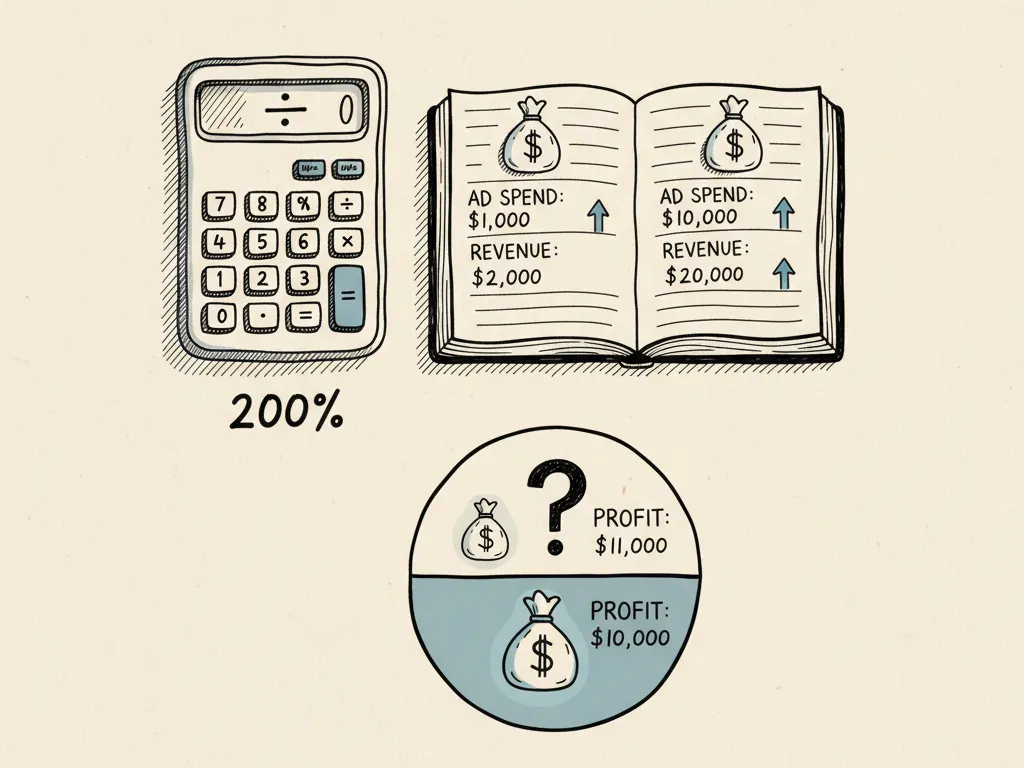
ROAS (return on ad spend) = revenue generated ÷ ad spend, often expressed as a ratio (e.g. 4:1) or multiple. It only accounts for ad spend and revenue, not product cost, overhead, or other marketing costs. ROI (return on investment) = (profit from investment − cost of investment) ÷ cost of investment, usually expressed as a percentage, and typically accounts for a fuller cost picture. A campaign can show a healthy ROAS and still be unprofitable once full costs are considered, which is why both numbers are useful, but neither alone tells the whole story.
Attribution limitations
Most customers interact with several marketing touchpoints before converting, an ad, an email, a search, a referral, so deciding which touchpoint 'caused' the conversion is inherently imperfect. Last-click attribution over-credits the final touchpoint; first-click over-credits discovery; multi-touch models try to split credit but rely on assumptions you should understand rather than treat as exact. Treat attributed numbers as directionally useful, not as precise accounting.
Formula sheet (deliverable)
| Metric | Formula | Common mistake |
|---|---|---|
| CPC | Total spend ÷ clicks | Treating a low CPC alone as proof of a successful campaign |
| CPM | (Spend ÷ impressions) × 1,000 | Using CPM to judge a conversion-focused campaign, it's an awareness metric |
| CTR | (Clicks ÷ impressions) × 100 | Ignoring that a high CTR with low conversion may mean misleading ad creative |
| CAC | Total acquisition cost ÷ new customers | Counting only media spend, excluding salaries, tools, and fees |
| LTV | Avg purchase value × frequency × lifespan | Not stating whether it's revenue-based or profit-based |
| ROAS | Revenue ÷ ad spend | Treating it as profit, when it ignores product and overhead costs |
Common mistakes
- Comparing CAC to revenue-based LTV instead of profit-based LTV, which overstates how much you can afford to spend.
- Reporting ROAS as if it were profit, when it only accounts for ad spend against revenue.
- Using last-click attribution numbers as if they were exact, rather than one useful but limited view.
- Mixing up CPM (cost per thousand impressions) with CPC (cost per click) in reporting.
- Calculating CAC over too short a period, before enough customers have been acquired to make the number meaningful.
When these simple formulas aren't enough
These standard formulas are appropriate for most small and mid-sized businesses evaluating a single channel or campaign. For businesses with long, multi-touch B2B sales cycles, subscription revenue with complex churn patterns, or multiple overlapping campaigns running simultaneously, more advanced attribution modeling and cohort-based LTV analysis is usually warranted; that level of depth is covered in later, more advanced articles in this curriculum.
- CPC, CPM, and CTR describe how an ad is delivered and clicked, not whether it produced a sale.
- CAC should include all costs to acquire a customer, not only ad spend, or it will understate the real cost.
- LTV can be measured on revenue or on profit; always state which one you're using, they aren't interchangeable.
- ROAS is revenue divided by ad spend; ROI typically accounts for profit and total costs, so the two can tell different stories.
- Attribution (which touchpoint gets credit for a conversion) has real limitations, treat multi-touch numbers as directional, not exact.