Once your Meta Ads account is set up, the next decision shapes everything that follows: which objective to choose, and how to structure campaigns and ad sets around it. Picking the wrong objective, or fragmenting your account into too many small pieces, is one of the most common reasons results feel disappointing even when the creative and offer are solid.
Matching objective to business outcome
Meta's campaign objectives are generally grouped around a handful of outcomes: awareness, traffic, engagement, leads, app promotion, and sales. Rather than memorizing every label, it helps to think in terms of what you're actually trying to achieve.
- Awareness or reach: useful when you want many people in a defined audience to see your brand, often before a product launch or in a market where almost nobody knows you yet.
- Traffic: useful when you want people to visit content, such as a blog post or a product catalog page, as part of research rather than an immediate decision.
- Leads: useful when the action you want is a form submission, call, or message, common for service businesses with a sales process after the enquiry.
- Sales: useful when you want a direct, trackable transaction, common for ecommerce or bookings with online checkout.
An objective-selection decision tree
- 1What action do you want the audience to take after seeing the ad?
- 2Can that action happen directly through the ad (form, message, purchase) or does it require a separate visit and decision?
- 3If direct and trackable: choose a leads or sales objective, depending on the action.
- 4If it requires research or browsing first: choose a traffic objective pointing to the relevant content.
- 5If the goal is visibility with no immediate action expected: choose an awareness or reach objective.
- 6Confirm the conversion location and optimization event available for your chosen objective in your account.
Avoiding needless fragmentation
A frequent mistake is creating many campaigns or ad sets to test small variations, splitting an already modest budget into pieces too small for any single ad set to gather enough data. Each ad set generally needs sufficient conversion volume within a review window to move past the early, noisier delivery period. If your total budget is limited, it is usually better to run fewer ad sets with more budget each than many ad sets with too little to learn from.
Campaign, ad set, and ad decisions
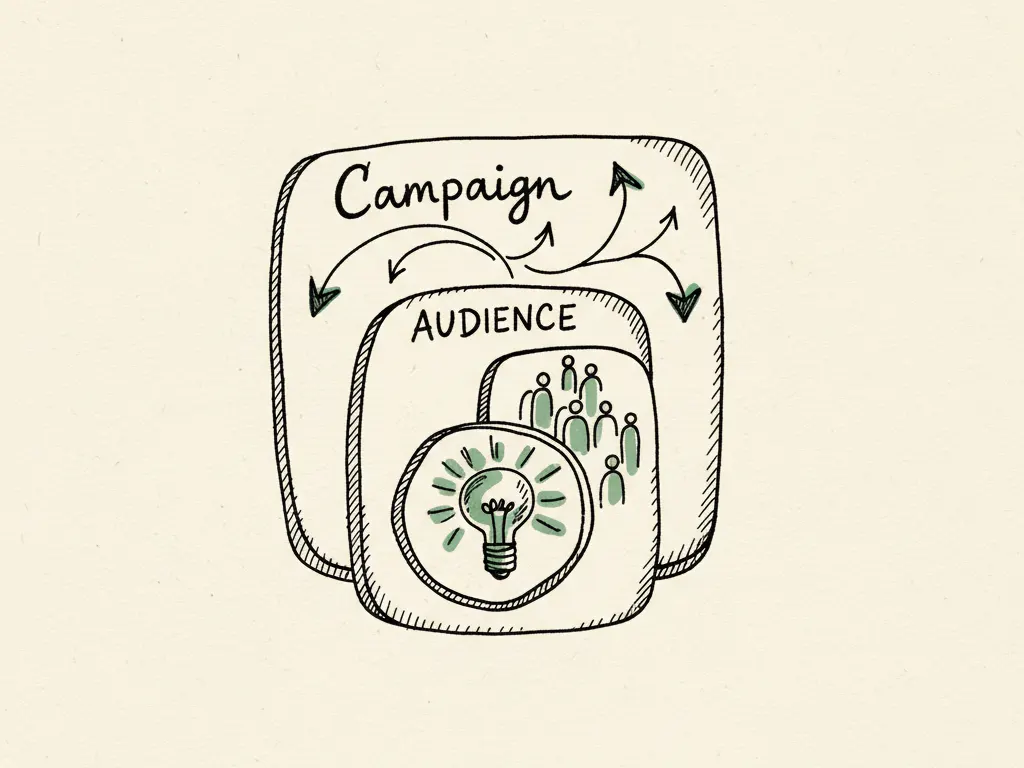
At the campaign level, you set the objective. At the ad set level, you set the audience, placements, budget, and schedule, so this is where you decide how many distinct audiences you genuinely need to test. At the ad level, you decide how many creative variations to run inside each ad set. A simple starting structure is one campaign per objective, a small number of ad sets representing genuinely different audiences, and two to four ads per ad set to let the system identify what resonates.
Distinguishing reach, traffic, leads, and sales outcomes in reporting
Each objective optimizes delivery toward a different signal, so comparing cost-per-result across objectives directly can be misleading. A traffic campaign's cost per link click is not comparable to a leads campaign's cost per form submission, because the platform is solving a different delivery problem in each case. Keep reporting organized by objective, and judge each campaign against the business outcome it was built to support.
A sample account map template
- One campaign per distinct business objective, named clearly (for example, 'Sales — Core Product')
- A small number of ad sets per campaign representing genuinely different audiences
- Two to four ads per ad set, varying the hook or format rather than only the image
- A naming convention that identifies objective, audience, and date for quick scanning
- A review cadence set in advance, not based on daily fluctuations
Common mistakes
- Choosing an objective based on vanity (reach, impressions) when the real goal is leads or sales.
- Creating a new ad set for every small audience idea instead of consolidating into fewer, larger ad sets.
- Comparing cost-per-result across different objectives as if they were measuring the same thing.
- Leaving default conversion locations unchecked instead of confirming they match the actual destination.
- Rebuilding the whole account structure every time results dip slightly, instead of waiting for a full review window.
When this is not the right tactic
If you are very early with a brand-new audience and almost no existing data, extensive structure and multiple objectives may be premature; a single, simple campaign focused on the most important business outcome is usually a better starting point than an elaborate account map. Similarly, if your budget is small, running a traffic or awareness objective alongside your core conversion objective may spread resources too thin to learn anything useful from either.
Where to go next
After structuring your campaigns, the next steps are learning how to plan audiences without unnecessary overlap, and understanding how budgets, bidding, and the learning phase interact so your account structure actually has room to perform.