Most 'creative testing' on Meta is really creative guessing: someone launches three ads that differ in five ways at once, picks the one with the best number after a day, and calls it a winner. That approach rarely teaches you anything repeatable, because you cannot tell which change actually mattered. This article walks through a disciplined way to test ad creative so each test produces a usable answer, not just a result.
The five layers of an ad's creative
Before testing anything, separate an ad into the parts that can each be changed independently. Treating 'the creative' as one blob is the main reason tests become unreadable.
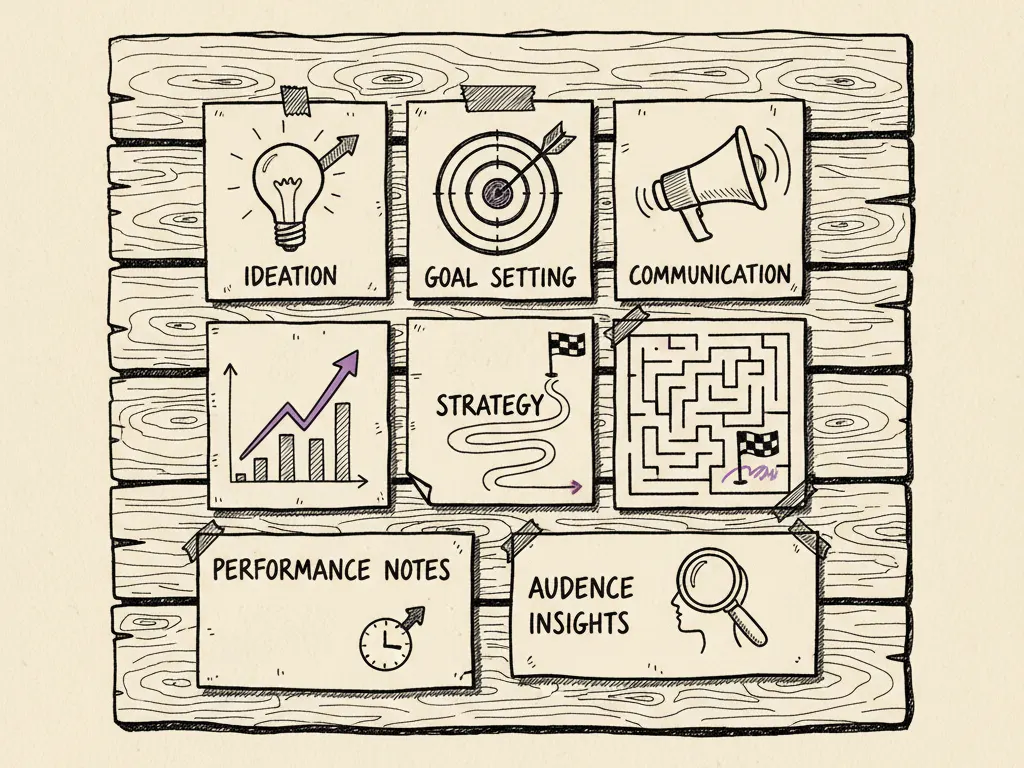
- Concept: the core idea or angle, for example 'busy parents save time' versus 'budget-conscious shoppers save money' for the same product.
- Hook: the first line, headline, or first two seconds of video that earns attention before anyone reads the rest.
- Proof: the evidence used to support the claim, such as a demonstration, a specific detail, a comparison, or a credible-sounding reason to believe.
- Format: the physical structure, for example a single image, a carousel, a short-form video, or a static graphic with on-image text.
- Offer: the actual deal or action being proposed, for example a discount, a free trial, a consultation, or 'shop now' with no incentive.
A genuine test changes exactly one of these layers between two otherwise identical variants. If you change the hook and the format in the same test, a better result cannot be attributed to either one specifically, and you have learned less than the spend would suggest.
Write the hypothesis before you launch
A hypothesis is a specific, falsifiable statement written down before the test runs, not a story invented afterward to explain whatever happened. A usable hypothesis names the variable, the expected direction, and the metric it should move.
Choose a decision metric before you look at results
Decide in advance whether the test is judged on click-through rate (CTR), cost per result, cost per acquisition (CPA), or return on ad spend (ROAS, attributed revenue divided by spend, which is not the same as profit). Choosing the metric after seeing results invites picking whichever one flatters the variant you already preferred.
- Top-of-funnel concept and hook tests are often judged on CTR or hook rate (percentage who watch past the first few seconds), since the goal is attention.
- Mid-funnel proof and offer tests are often judged on cost per landing-page view or add-to-cart.
- Full-funnel tests, when budget allows enough volume, are judged on CPA or ROAS, since the real goal is the eventual outcome, not the click.
- 1Pick one creative layer to change: concept, hook, proof, format, or offer
- 2Write the hypothesis and the decision metric before launch
- 3Build two (or a small number of) variants that differ only in that layer
- 4Run until each variant reaches a sensible spend and impression threshold
- 5Compare against the predefined metric, then document the conclusion in a test log
Why small samples mislead you
Ad platforms show results in real time, which tempts people to call a winner after a few hundred impressions or a handful of clicks. Early differences are often noise: a variant can appear to 'win' simply because a handful of unusually fast-converting people happened to see it first. There is no single universal threshold that applies to every account, but a reasonable discipline is to wait until each variant has accumulated enough spend to produce a meaningful number of the actual outcome you're measuring (clicks for a CTR test, purchases for a CPA test) before declaring a result, and to be explicit that a close result with limited volume is inconclusive rather than a loss.
Creative learning and why constant swapping backfires
Meta's ad delivery system uses the signals an ad receives (clicks, conversions, engagement) to decide who to show it to next. Swapping creative too frequently, before it has gathered enough signal, can repeatedly restart this learning process and make every ad look underwhelming, not because the creative is weak but because delivery never stabilizes. This is a reason to test with intention rather than refreshing creative constantly out of boredom or anxiety about ad fatigue.
Build a creative test matrix
Documenting tests, even briefly, is what turns a series of one-off experiments into an asset the whole team can learn from. The deliverable for this lesson is a simple matrix.
| Test # | Layer changed | Variant A | Variant B | Spend A / B | Metric | Result | Conclusion |
|---|---|---|---|---|---|---|---|
| 1 | Hook | Benefit-led line | Problem-led line | $400 / $400 | CTR | 1.1% / 1.8% | Problem-led hook wins; use as new baseline |
| 2 | Proof | Before/after image | Customer quote | $350 / $350 | Cost per add-to-cart | $6.20 / $8.40 | Image wins; retire quote variant |
- Hypothesis and decision metric are written down before launch
- Exactly one creative layer differs between variants
- Spend and audience size are roughly even across variants
- A minimum spend or result threshold is set before reading results
- The test log records the result and a plain-language conclusion
Common mistakes
- Changing hook, format, and offer simultaneously, then crediting the win to whichever one you liked most.
- Declaring a winner after a few hours of spend with very few actual conversions.
- Testing only the first three seconds of video without ever testing proof or offer, which often moves results more.
- Treating a single test's winner as permanent instead of periodically re-testing as audiences and fatigue change.
- Confusing a CTR win with a business outcome, when the real goal might be purchases or qualified leads further down the funnel.
When this is not the right tactic
Formal creative testing needs enough budget and volume to reach a meaningful read; a very small daily budget split across several variants may never accumulate enough data to conclude anything, in which case it is often better to run one strong variant at a time sequentially and compare periods, clearly noting that sequential comparisons are weaker evidence than a true split test because other factors can change between periods. Early-stage businesses still searching for product-market fit may also get more value from direct customer conversations than from formal ad experiments, since no amount of hook testing fixes an offer nobody wants.