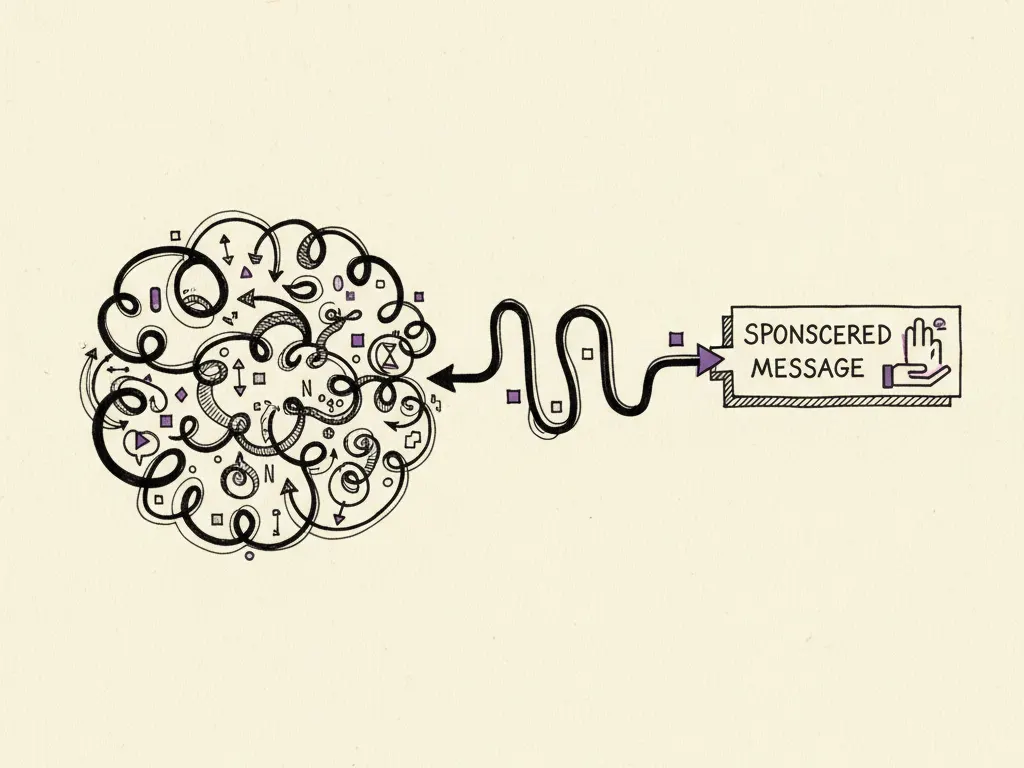
Before you can design any AI advertising campaign well, you need to know what people are actually asking, not what you assume they ask. Conversational interfaces like ChatGPT surface a different kind of language than search boxes: longer, more specific, often phrased as a problem rather than a keyword. 'Best CRM for a 10-person agency' is a search query. 'I run a 10-person agency and keep losing track of client follow-ups, what should I use' is closer to how someone might phrase the same need in a conversation. Intent research is the work of understanding that difference and planning around it.
This article is about research and planning, not platform mechanics. It produces a matrix you can hand to the people designing creative, campaigns, or content; it does not claim any ability to see or target an individual's private conversation with an AI assistant, and it does not claim access to prompt-level targeting beyond whatever a platform's official documentation actually supports.
Three layers of a customer question
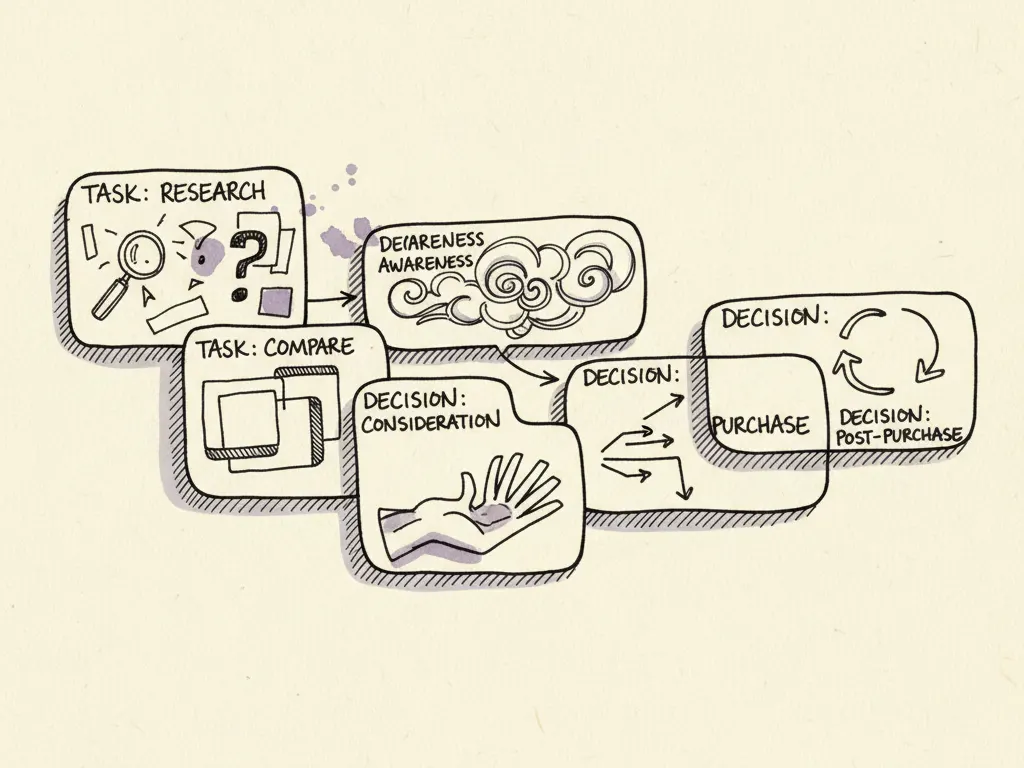
Every real customer question can be read on three levels, and conflating them produces generic, low-relevance marketing.
- 1Explicit query: the literal words typed or spoken
- 2Underlying task: what the person is actually trying to accomplish
- 3Buying context: where this sits in their decision process, and what would move them forward
Take the question 'how much does bookkeeping software cost.' The explicit query is about price. The underlying task might be deciding whether to do bookkeeping in-house or outsource it. The buying context might be early research, long before they are ready to pick a specific vendor. An ad or piece of content that answers only the explicit query (a price list) misses the chance to address the underlying task (a comparison of in-house versus outsourced costs) that would actually move the decision forward.
Where to find real questions
Resist the temptation to guess. Pull actual language from sources you already have access to.
- Support tickets and live chat transcripts, searched for recurring phrasing, not just topics.
- Sales call notes or recordings, focusing on the first question a prospect asks unprompted.
- Search Console or keyword tools, read as questions rather than isolated keywords.
- Public reviews and forum threads about your category, noting complaints and comparison language.
- Your own team's answers to 'what do people always ask us before buying', collected directly from frontline staff.
Building the question-to-intent-to-offer matrix
Once you have a list of real questions, group them by underlying task, then by buying stage, then attach the offer or content asset that best serves each group. This is the deliverable for this lesson: a working matrix, not a long list of disconnected questions.
| Explicit question (examples) | Underlying task | Buying stage | Best offer or asset |
|---|---|---|---|
| "How much does X cost", "Is X worth it" | Deciding whether the category is worth the cost at all | Early research | Comparison guide or cost calculator, not a sales call |
| "X vs Y", "Best X for [specific situation]" | Narrowing between a small set of options | Active comparison | Side-by-side feature page, case study, or free trial |
| "How do I set up X", "Does X integrate with Y" | Reducing risk before committing | Near decision | Demo booking, onboarding walkthrough, or guarantee details |
Separating research assumptions from platform targeting
This matrix tells your team what to say and to whom conceptually. It does not tell you what an ad platform can actually target. Before building a live campaign around any row in the matrix, check the platform's current official documentation for what targeting, matching, or contextual placement options genuinely exist. Treat the matrix as a creative and content brief first, and a targeting brief only once verified against real platform capability.
Handling sensitive inferred characteristics responsibly
Some real customer questions imply sensitive characteristics, for example, financial distress, a health condition, or a major life event. Even when a question seems to reveal this, do not build targeting or messaging that exploits the inference. Keep offers centered on the stated task (for example, 'comparing debt consolidation options') rather than the inferred vulnerable state (for example, 'struggling financially'), and avoid any targeting logic that singles people out by such inferred categories.
A simple research checklist
- Collected at least 20 to 30 real customer questions from support, sales, search, and reviews
- Classified each question by underlying task, not just literal topic
- Grouped tasks into a small number of buying stages
- Mapped each group to one clear offer or content asset
- Flagged any questions implying sensitive characteristics and excluded them from targeting logic
- Checked the matrix against actual platform documentation before any live targeting decisions
Common mistakes
- Writing the matrix from guesses about what AI users 'probably' ask instead of real collected language.
- Treating the explicit query as the whole intent and ignoring the underlying task.
- Assuming a research matrix equals actual platform targeting capability.
- Building messaging that exploits an inferred sensitive characteristic instead of addressing the stated task.
- Creating one offer for all buying stages instead of matching the offer to where the person actually is.
- Letting the matrix go stale; customer language shifts as your market and competitors change.
When this is not the right tactic
If you do not yet have enough real customer interactions to draw from, for example a brand-new product with no support tickets, sales calls, or reviews, this method will produce guesses dressed up as research. In that case, start with direct customer interviews or a small number of structured sales calls to generate real language first, then build the matrix. This approach is also overkill for a very narrow, single-offer business where every visitor has essentially the same intent; in that case, a simpler single-path message may serve just as well.
Where this fits
This matrix is the input to campaign design work like the ChatGPT Ads specification process, and it also informs organic content and search strategy more broadly. Treat it as a living document, refreshed whenever you notice new recurring questions from customers.