One of the most common questions a business owner asks a marketer is 'when will this work?' The honest answer is that marketing produces several different kinds of results, and they arrive at different speeds. Treating all of them as one timeline is where most frustration and most broken promises come from.
This article separates four distinct outcomes, explains what typically drives their speed, and gives you a framework for setting review dates that match what each outcome can realistically show you.
Four outcomes, four timelines
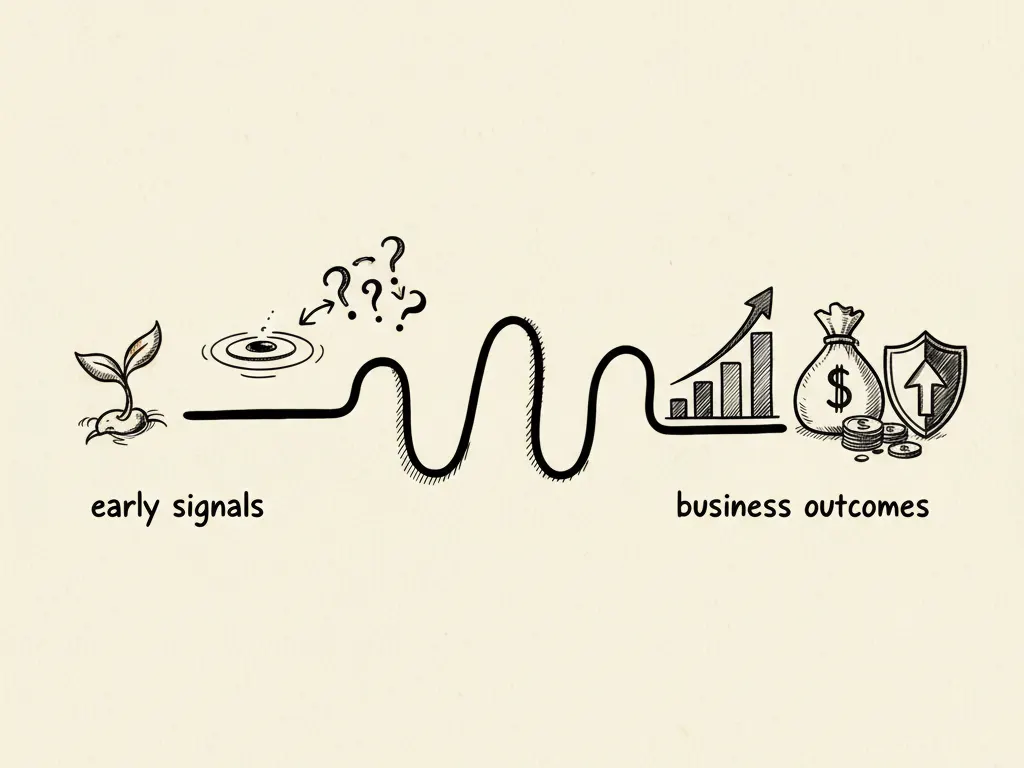
Marketing activity does not move in a straight line from zero to revenue. It passes through stages, and each stage has its own leading signals and realistic timeframe.
First traffic
This is the fastest outcome to produce. A paid ad can generate clicks within hours of launch. A social post can get views the same day. First traffic tells you whether your creative and targeting are reaching people at all, but it says nothing yet about whether those people are the right people or whether they will buy.
Qualified demand
Qualified demand is interest from people who actually match your ideal customer: a form submission with a real budget, a reply to an outreach message, an email signup from someone in your target industry. This usually takes longer than first traffic because it requires your message, offer, and targeting to actually be matched to the right audience, which typically needs at least one or two rounds of adjustment.
Cash revenue
Revenue depends heavily on your buying cycle. A low-cost ecommerce product might convert within the same browsing session. A B2B service with multiple stakeholders and a procurement process might take weeks or months between first contact and signed contract, no matter how well the marketing performed. Revenue timelines are driven as much by the customer's decision process as by your marketing.
Repeatable profitable growth
This is the slowest and most valuable outcome: a process that reliably turns a given spend or effort into a predictable amount of qualified demand and revenue, cycle after cycle. Reaching this stage usually requires multiple test-and-learn cycles, enough data to separate signal from noise, and enough time for seasonal or cyclical effects to show up at least once.
Why channel maturity changes everything
The same business can see very different timelines across channels because each channel starts from a different position of maturity.
| Factor | Paid ads | SEO / organic content | Email / owned list | Referral / partnerships |
|---|---|---|---|---|
| Time to first traffic | Hours to days | Weeks to months (indexing, ranking) | Immediate if list exists | Weeks (relationship building) |
| Time to qualified demand | Days to weeks (after targeting tuning) | Months (content needs to rank and earn trust) | Days to weeks | Weeks to months |
| Dependence on existing assets | Low (budget substitutes for audience) | High (domain authority, content history) | High (list size and engagement) | High (existing relationships) |
| Typical time to compounding returns | Ongoing optimization, not usually compounding | 6-12+ months as content library grows | Grows with list size over time | Grows as network expands |
None of these speeds is universally 'better.' A new ecommerce brand with budget to test might see paid ads produce revenue signals within the first two weeks, while a service business relying on SEO content might not see meaningful organic traffic for three to six months. Both can be correct strategies; they are just on different clocks.
Buying cycles change the review date, not the quality of the work
A short buying cycle (impulse purchases, low price point) means revenue can validate or invalidate a campaign quickly. A long buying cycle (enterprise software, home renovation, B2B contracts) means revenue lags far behind marketing activity, even when the campaign is working. If you judge a long-cycle business by 30-day revenue, you will likely kill a campaign that was actually on track, because the qualified demand it produced simply has not had time to become revenue yet.
Setting review dates around leading and lagging signals
The practical fix is to set two kinds of checkpoints for every channel: one for leading signals (which tell you early whether the mechanics are working) and one for lagging signals (which tell you whether the business actually benefited).
- Week 1-2: are impressions and clicks delivering at the expected volume and cost? (leading)
- Week 2-4: is the audience engaging in a way that suggests fit (CTR, time on page, reply rate)? (leading)
- Week 4-8: is qualified demand appearing at a believable rate for your industry? (leading-to-mid)
- End of one full buying cycle: has qualified demand converted into any revenue? (lagging)
- After 2-3 full cycles: is the cost-to-outcome ratio stable or improving? (lagging, growth signal)
A deliverable: channel-and-stage timeline with diagnostic checkpoints
Use this structure to set expectations before a campaign launches, so that a slow lagging metric does not get mistaken for failure.
- List the channel(s) you're using and note their current maturity for your business (new vs. established).
- Write down your typical buying cycle length in days or weeks, based on sales history or a reasonable estimate if you're new.
- For each channel, set a leading-signal checkpoint at roughly 2-4 weeks: what traffic and engagement level would tell you the mechanics are working.
- Set a lagging-signal checkpoint at one full buying cycle: what qualified demand and revenue level would tell you the channel is converting.
- Set a growth checkpoint at two to three full cycles: is the ratio of cost to outcome holding steady or improving.
- Document what you will do at each checkpoint if the signal is below expectation: adjust, pause, or wait one more cycle.
Common mistakes
- Judging a long-buying-cycle business by short-term revenue instead of qualified demand.
- Comparing a brand-new channel's week-one results to an established channel's steady-state performance.
- Treating 'no results in 30 days' as proof of failure without checking whether 30 days covers even one full buying cycle.
- Changing strategy, budget, and creative all at once, so you can no longer tell which change affected the outcome.
- Promising clients or stakeholders a fixed date for revenue without first establishing the buying cycle length.
When a fixed timeline is not realistic
If a business genuinely needs revenue within a specific short window, for example 30 days, the honest answer is to choose channels and offers suited to that window (a paid campaign with a time-limited promotion aimed at warm, bottom-of-funnel audiences) rather than expecting SEO, content, or cold outreach to compress into that timeline. These slower channels can still be started in parallel for future benefit, but they should not be the basis for a near-term revenue promise.
Where to go next
Read the article on measuring real marketing ROI for how to reconcile these timelines with actual cost and profit reporting, and revisit the marketing funnel article for how traffic moves through each stage toward revenue.