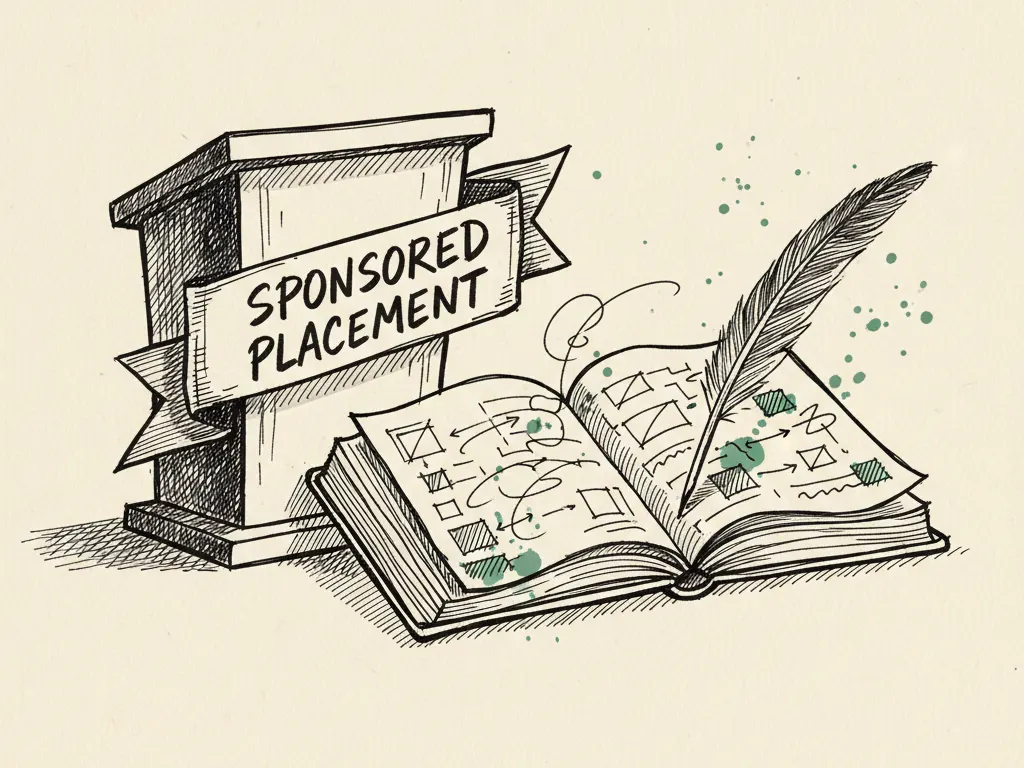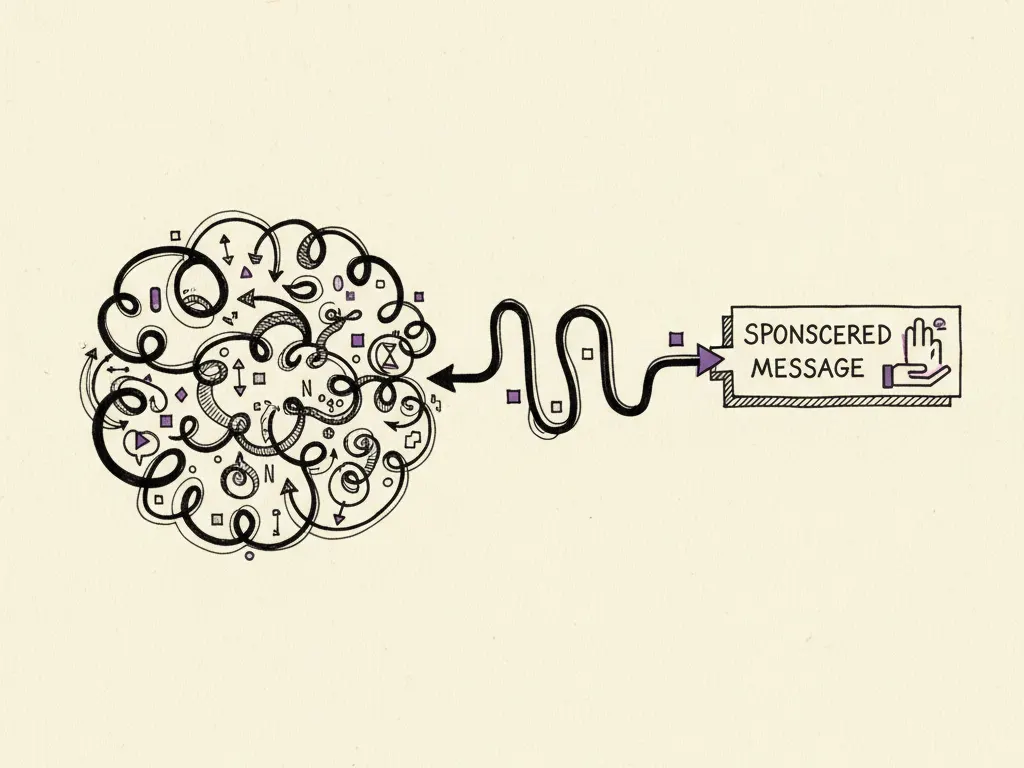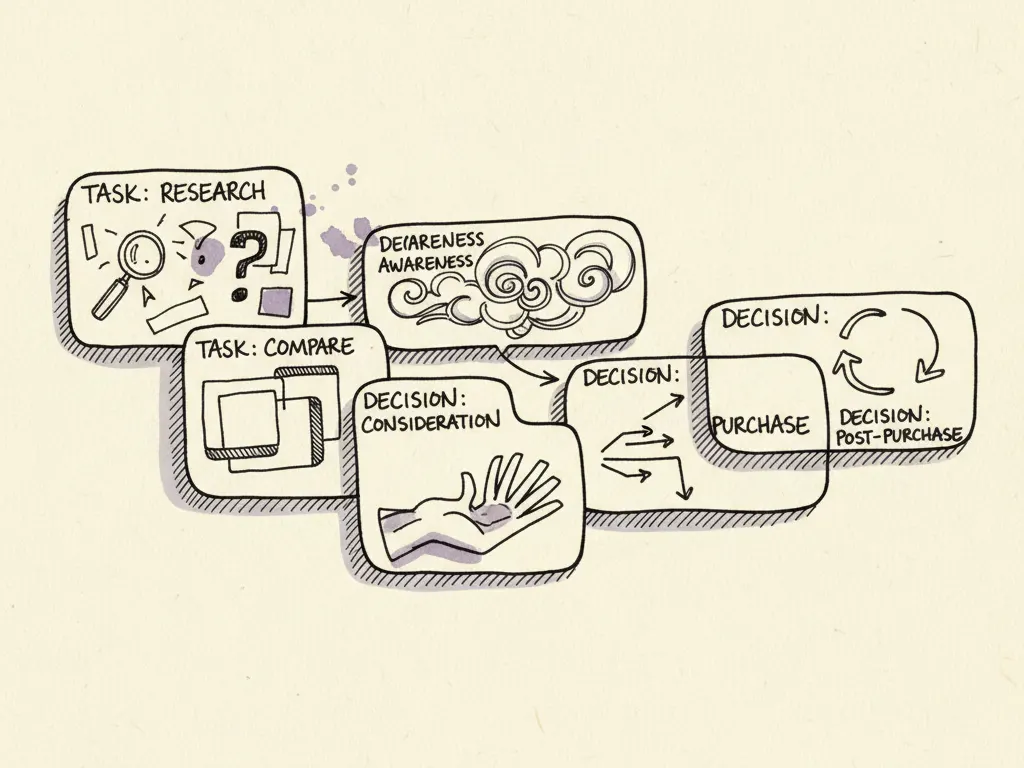
Terms like 'sponsored agents' and 'conversational commerce' get used loosely, often conflating four genuinely different things: a paid ad placement inside a chat product, a business using an AI assistant to help manage ads on another platform, a platform's own automated ad-buying features, and a brand's organic visibility when an assistant answers a question unprompted. This article focuses specifically on the first concept, paid, disclosed promotional interactions, often called sponsored conversations or sponsored agents, and on conversational commerce, the broader idea of completing parts of a shopping journey through chat.
What a sponsored agent or sponsored conversation actually means
In the context relevant here, a sponsored agent or sponsored conversation is a paid, clearly disclosed promotional interaction that a user may encounter inside a chat assistant, separate from the assistant's unpaid, independent responses to that same user's questions. The distinguishing features worth verifying for any such program are: how the sponsorship is disclosed to the user, whether the advertiser can see or influence the content of the underlying independent answer, what data the advertiser receives about the interaction, and which advertisers currently have access.
It is important not to describe paid placements as a way to influence or buy priority within an assistant's unpaid, independent answers. Those are, and should remain, conceptually separate: one is advertising, disclosed as such, and the other is the assistant's own response generation. Conflating them, even unintentionally, misleads readers about how these systems work.
Conversational commerce beyond sponsorship
Conversational commerce does not require paid sponsorship to exist. A user can already ask a general-purpose AI assistant to compare product categories, summarize public reviews, or explain how a type of product works, all using information the assistant has access to without any advertiser payment involved. Some platforms are also developing features that let a user complete more of a purchase journey (browsing, comparing, checking out) without leaving a chat interface. Whether and how a given business's products appear in these flows depends on technical integration (such as structured product data) as well as, in some cases, separate advertising relationships. These are two different levers, and a business should understand which one it is pulling before describing results to a client or stakeholder.
| Concept | Is it paid? | Who controls it |
|---|---|---|
| Sponsored agent / sponsored conversation | Yes, paid and disclosed | Advertiser pays the platform; platform discloses to user |
| Independent assistant answer | No | The assistant's own response generation, not purchasable |
| Platform automation for ad buying | Indirectly, affects paid campaigns | Platform-provided tools for advertisers managing their own paid campaigns |
| Organic visibility in AI answers | No | Influenced by content quality, structure, and evidence, not payment |
A capability-status table
The deliverable for this lesson is a capability-status table you can keep updated as official information changes. Treat every row as something to re-verify, not a permanent fact.
| Capability | Status as of 3 Oct 2026 (verify before relying on it) | Source to re-check |
|---|---|---|
| Sponsored Agents / sponsored conversations | Described in a September 2026 announcement as a test with selected US advertisers, not broadly available | Official OpenAI advertiser and business documentation |
| General ChatGPT Ads (Ads Manager-style setup) | An existing advertising product with official setup documentation; exact objectives, formats, and availability vary by account and region | OpenAI advertising help resources |
| Conversational checkout or purchase completion in chat | Capabilities in this area have been discussed and piloted; exact current scope and eligibility should be verified directly | Official OpenAI product announcements |
| Organic brand mentions in independent chat answers | Not a paid or purchasable placement; influenced by content quality and evidence, not advertising spend | Not applicable; this is organic, not paid |
Preparation steps for businesses without current access
Even without access to a specific sponsored placement program, a business can prepare in ways that will matter whenever broader access does arrive, and that also improve organic visibility in the meantime.
- Maintain clean, structured, current product or service data (names, pricing, availability, policies)
- Publish clear, accurate, original content that answers common customer questions, supporting organic AI visibility
- Document your return, shipping, and support policies in one authoritative, easy-to-find place
- Assign one team member to monitor official announcements from the relevant AI platform on a fixed schedule
- Avoid any vendor or agency claim of guaranteed access, placement, or priority in a program that has no public self-serve process
- Keep a dated internal note of what you verified and when, so claims do not go stale silently
User expectations and disclosure
Whatever the exact mechanics of a future broader rollout, user trust depends on clear disclosure: people should be able to tell when a response or recommendation is part of a paid interaction versus the assistant's independent answer. Businesses considering any sponsored conversation format should plan for compliance with the platform's disclosure requirements and should not design creative or scripts that attempt to blur that distinction, both because it is against platform policy in general and because it damages the exact trust that makes conversational commerce valuable in the first place.
Common mistakes
- Describing a limited test program as if it were broadly available to any advertiser today.
- Conflating paid sponsored conversations with the assistant's independent, unpaid answers.
- Promising a client access to a feature with no public self-serve application process.
- Treating 'conversational commerce' and 'sponsored agents' as synonyms when they are related but distinct concepts.
- Failing to put a re-verification date on any claim about availability, since test programs change scope.
When this is not the right tactic
If your business has no confirmed access to a sponsored placement program, building a campaign plan around it is premature; focus budget on channels you can actually activate today. It is also not the right focus for a business whose customers are unlikely to use conversational AI assistants for the relevant purchase category, in which case the preparation steps here (clean data, clear content) still help organic visibility but a dedicated conversational commerce strategy would be a low priority relative to other channels.
Where to go next
Read the lessons on AI search visibility and ChatGPT Ads fundamentals to understand the organic and currently-available paid levers you can pull today, and keep this article's capability-status table as a living document you update whenever you re-verify official sources.