Most companies run marketing as a series of disconnected campaigns: a paid social push this month, an email promotion next month, a content sprint after that. Each campaign produces a short-lived spike, and performance resets to baseline once it ends. A growth system is different: it is a set of connected mechanisms where the output of one stage becomes the input of another, so gains compound over time instead of evaporating.
This is a pro-level, applied article. It assumes familiarity with basic growth marketing concepts and the AARRR-style funnel (acquisition, activation, retention, referral, revenue), and focuses on how to actually design and run a system rather than just naming the stages.
Funnel vs loop: a critical distinction
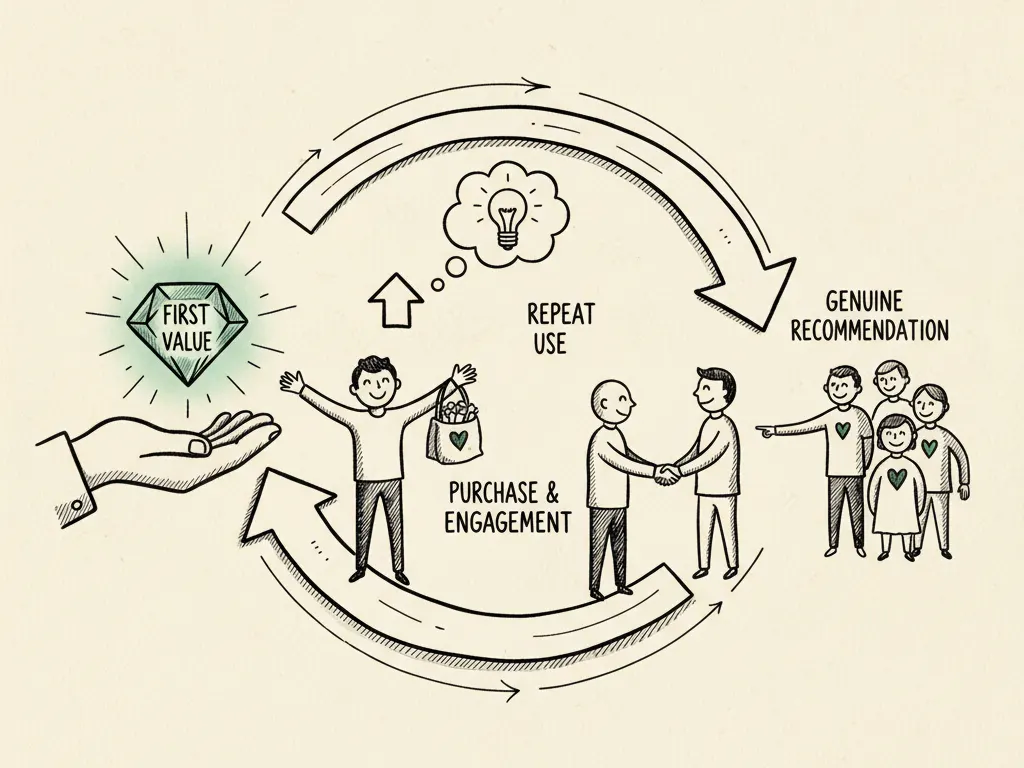
A funnel is linear: traffic goes in, customers come out the bottom, and the process starts over from zero demand each time. A loop is circular: an output at one stage becomes a new input at another. A classic example is a referral loop, where retained, satisfied customers refer new customers, who themselves retain and refer again. The loop keeps feeding itself; the funnel does not. A growth system is built from several interacting loops layered on top of a baseline funnel, not a bigger or shinier funnel.
| Aspect | Funnel | Loop |
|---|---|---|
| Shape | Linear, ends at a sale | Circular, output feeds back as input |
| Starting point each cycle | Zero, requires new traffic | Partially self-fueled by existing customers |
| Typical metric | Conversion rate per stage | Loop cycle time and multiplier (e.g., referrals per customer) |
| Failure mode | Spend stops, traffic stops | Loop breaks if any link underperforms |
Step 1: Map the journey into five stages
Start by mapping the customer journey into acquisition (how people first discover you), activation (the first moment they experience real value), retention (whether they come back or keep using the product/service), referral (whether they tell others), and revenue (how and when money changes hands, including expansion or repeat purchase). For each stage, write down the current approximate conversion rate or frequency, even if it's a rough estimate from available data.
Step 2: Identify the single biggest bottleneck
Teams often try to improve every stage simultaneously, which spreads effort too thin to move any single metric meaningfully. Instead, identify where the biggest drop-off or weakest point is relative to what is realistic for the business model. A SaaS business with strong signups but 80% churn in month one has an activation or onboarding problem, not an acquisition problem; more top-of-funnel spend there is close to wasted.
Step 3: Design loops, not more campaigns
Once the bottleneck is identified, design a loop that directly addresses it rather than another isolated campaign. Common loop types include: content loops (content attracts an audience, which shares it, which attracts more audience), referral loops (satisfied customers invite others, often with an incentive), and retention-to-expansion loops (engaged customers upgrade or buy more, funding further product or service investment). Choose the loop type that matches where your bottleneck sits.
Step 4: Assign owners and a shared metric
A loop that crosses acquisition, product, and customer success will fail if only the marketing team is accountable for it. Each loop needs a single accountable owner (even if work spans teams), a running experiment with a hypothesis and a review date, and one shared metric that all contributing teams can see and influence, such as 'activated-to-retained rate at day 30' rather than separate, siloed KPIs per team.
Step 5: Measure compounding, not just campaign ROAS
Campaign-level ROAS (return on ad spend) tells you whether a single push was efficient; it does not tell you whether the business is compounding. Track loop-level multipliers over time: are referrals per customer increasing quarter over quarter? Is the cost to acquire a customer falling as organic/referral volume grows as a share of total acquisition? Is retained-customer lifetime value increasing as onboarding improves? These system-level trends are the real sign a growth system, not just a good campaign, is working.
Illustrative values for a hypothetical business as referral loop investment increases; not a benchmark or guarantee for any real business.
Template: the growth-system map
Use this as the deliverable for this lesson: a one-page map naming, for each of the five stages, the current approximate metric, the identified bottleneck stage, the loop being built to address it, its owner, its running experiment, and its shared metric.
- List acquisition, activation, retention, referral, revenue with current rough metrics
- Mark the single biggest bottleneck stage with supporting evidence
- Name the loop type chosen to address that bottleneck
- Assign one accountable owner across the teams the loop touches
- Write the current running experiment and its hypothesis
- Define the one shared metric all contributing teams track
- Set a review date to decide: keep, redesign, or retire the loop
Coordinating teams around a system
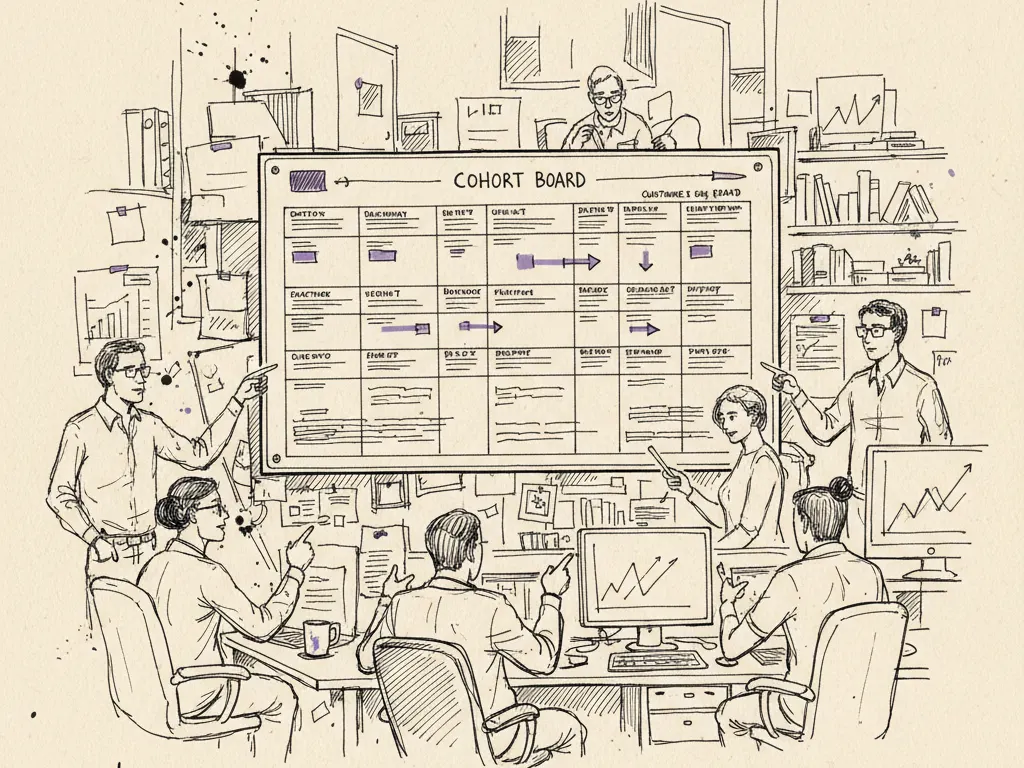
Because loops cross functional lines, a short recurring sync (biweekly is common) between marketing, product/ops, and sales or support keeps the shared metric visible and prevents each team from quietly reverting to isolated campaign thinking. The sync should review the shared metric and the status of the running experiment, not a list of individual team activities.
Common mistakes
- Relabeling an ordinary funnel as a 'growth loop' without an actual feedback mechanism.
- Trying to improve all five stages at once instead of focusing on the single biggest bottleneck.
- Giving a loop to one team to own when it depends on decisions made by another team entirely.
- Measuring only campaign-level ROAS and missing whether the system is compounding over quarters.
- Launching a referral program before retention is strong enough to generate genuinely satisfied referrers.
- Treating the system map as a one-time document instead of revisiting it as the bottleneck shifts.
When this is not the right tactic
A full growth-system build is premature for a brand-new business with no product-market fit evidence yet; in that stage, simple, direct campaigns to validate demand matter more than designing compounding loops around an unproven offer. It is also not worth the coordination overhead for a very small, simple business with one owner and no cross-functional teams to coordinate; a lighter version (pick one loop, run it personally) captures most of the benefit without the structure.
Your next step
Map your five stages with current rough numbers, identify your single biggest bottleneck honestly, and design one loop (not three) to address it using the template above. Assign an owner and a review date before you build anything else.